Nintendo Consoles

Nintendo Consoles
Showing posts with label beyond good and evil. Show all posts

Sunday, January 24, 2016

Madagascar...DUH.

Movie tie-in games are legendary for providing gamers with mediocre non-canon, filler, or just plain garbage. Children's games are known to be occasionally fun, but usually go unconsidered. Low expectations can often precede impressive surprises, but what happens when you have a movie tie-in that takes the form of a children's game? Usually mediocrity. But is this the case with one of the many games I have owned for years but up until recently never had the interest to play?

Madagascar - Nintendo Gamecube

Yes, this is totally the case. Madagascar is really mediocre. I mean, duh, right? It's a "kid's game". But I wanted to play this game after noticing that I had no idea what made kid's games bad. I don't remember disliking kid's games as a child, yet I no longer play them as an adult. Why? Let's find out.

(for real) Madagascar - Nintendo Gamecube

Madagascar the video game, based on the Dreamworks movie of the same name, is an action-platformer that combines many different types of gameplay into one coherent title with a strong emphasis on plot and surprisingly little to no repetition. The main game is broken up into levels that take anywhere from 10 to 20 minutes to complete. The levels are easy, and there are only enough to make up what comes out as a 4-5 hour game, but each level introduces one or more additional mechanics that keep gameplay fresh, yet never stop it from becoming boring. Each level has you playing as one or more members of the cast of the Madagascar movie, and the dialogue (as well as the entire game, for that matter) does not assume that the player is already familiar with the source material.

The constant switching of characters contributes largely to keep the gameplay fresh. Each of the 5 characters you play as have enough of the same moves in common, such as jump or attack, to ensure a smooth transition from character to character, but have enough unique moves to justify the transition in the first place. Levels are designed around the moveset of each character used to complete them: Alex with his double-jump ability is featured in many of the levels that focus on platforming, Gloria with her large collection of attacks is featured in levels that emphasize combat, etc.

The problem is that while the gameplay is varied, it is simple and unrewarding. The issue with these kids games is that while they are not particularly offensive on their own  (aside from some hilariously bad graphics and unpolished optional mini-games) there is nothing satisfying about playing them.

Of course the argument would be made that no kids game could satisfy the needs of an experienced adult gamer, but I would be very quick to disagree. That which is known as a "skill-cap" is the amount of time or practice that must be devoted to a video game in order to master it as thoroughly as possible. If a game has a high skill cap, then it can be said that the game requires a lot of practice and/or time to master it, while a game with a low skill-cap may require virtually no practice in order to achieve mastery status. Satisfaction in video gaming comes with having achieved mastery despite a high skill-cap. Some games have a high skill cap despite being easy to play- this would be an example of "easy to play, hard to master", a phrase that adequately describes many titles. Many kids games are "easy to play, hard to master", but Madagascar is not one of them, and thereby scratches no itch.

Kid's games can be fun under particular conditions. I am familiar with many kid's games that become more fun as knowledge of their nuances is gained, but Madagascar is not an example of such a title. Though not particularly lazy in any one department, it does not pose enough of a challenge, nor does it possess a high enough skill cap, to yield a satisfying victory.

Saturday, January 9, 2016

Yu-Gi-Oh! The Eternal Duelist Soul

The early 2000's was no stranger to trends that would be known to spellbind the hearts and hands of young gamers. The new millennium introduced us nerds to popular and memorable franchises such as Guitar Hero, World of Warcraft, and Call of Duty, but among the games competing to shine the brightest was a more traditional game, a trading-card game, that ruled supreme for half a decade; that card game was Yu-Gi-Oh!

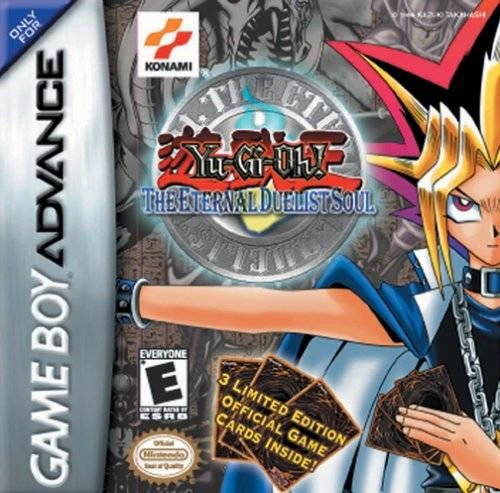
Yu-Gi-Oh! The Eternal Duelist Soul - GBA

The popular Japanese manga-turned-game-turned-international sensation saw many different video game interpretations, some re-imagining Yu-Gi-Oh! as a turn-based RPG, to an open-world Pokemon-ish game, while other publications stuck to the rules and characters that made the franchise popular in the first place, and few accomplished the later more successfully than Yu-Gi-Oh! The Eternal Duelist Soul. 

Unlike many other entries to its video game career, Yu-Gi-Oh! The Eternal Duelist Soul sticks to the original rules of the traditional card-based game; it's these same rules with which EDS expects players to be preemptively familiar in order to play, as there exist no tutorials in EDS, making it somewhat impenetrable to gamers unfamiliar with Yu-Gi-Oh! That being said, the game initially offers opponents that are fairly easy to defeat, and as a result it may not be too difficult for determined newbies to quickly get the hang of what winds up becoming a fairly challenging game. The experience of Yu-Gi-Oh! video games will always inevitably be different for those who are long-time fans and those who have never played before, but since EDS doesn't allow you to make moves or play cards that don't abide by the rules of the game, it doesn't really take too long for novices to become familiar with what does and doesn't work.

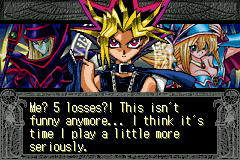
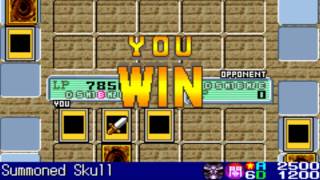
Players begin the only single-player game mode by selecting from 1 of 3 decks to get you started. There is no way of knowing which decks contain which cards, but all 3 are sufficient for getting you through your first few duels once you become familiar with the rules of the game. Initially, you have the option of dueling against 5 faces familiar to even the most casual Yu-Gi-Oh! fan, and additional opponents are unlocked after having defeated each character in each tier a specific number of times. Each collection of characters unlocked serves not only as fun guides through the first 2 seasons of the Yu-Gi-Oh! anime, but becomes increasingly difficult and fun to duel against. After you win any duel against any opponent, you are brought to a screen where you get to choose 1 booster-pack to open. Each booster pack holds cards that are unlocked and available to you after selecting to claim them, though once again the contents of each pack is random until it is opened. Constant acquisition of additional cards that you are encouraged to add to your deck helps to keep things from becoming stale. Abstaining from making changes to your deck may result in frequent loses as the skill of your newest opponents becomes more considerable, so having a consistent influx of new cards is an efficient way to make progress and pacing fluid. 

The goal of the game is to advance to and then win the Yu-Gi-Oh! World Championship. Each duel either won or lost advances the calendar by a single day, and there are a great number of days to get through before the Yu-Gi-Oh! World Championship arrives. Players will spend most of these calendar days dueling against new opponents to unlock more cards and characters. Unfortunately, there is an extremely large number of days between unlocking the final opponent and unlocking the World Championship, and the game slows to a grinding hault during this second half, which abruptly withholds new content. 

Though there are now countless Yu-Gi-Oh! video games out there, I find myself drawn to replay Eternal Duelist Soul every couple of years. The best part about Eternal Duelist Soul is that despite it featuring out-dated cards and strategies, the cards it does feature are the original cards, and your opponents are the original characters from the original cast. Eternal Duelist Soul is to Yu-Gi-Oh! as Red and Blue are to Pokemon. The value in EDS lays in its ability to encourage casual fans to sharpen their knowledge of the basics of the real-life game. Attempting to dive head-first into the world of Yu-Gi-Oh! nowadays can be a tall order, and introducing a new duelist to the latest strategies and combinations can be daunting, but playing these old video games that are more-or-less Yu-Gi-Oh! simulators can be extremely helpful for one trying to begin to play the real-life game. Moreover, EDS and other old Yu-Gi-Oh! games are fun for veteran fans who may have missed out on the opportunity to use old cards and strategies that may have seemed fun at the time but are now out-dated. My Exodia deck is unmatched in this period of Yu-Gi-Oh's history. 

Retrospectively, Yu-Gi-Oh! The Eternal Duelist Soul doesn't offer anything that can't be found in any other Yu-Gi-Oh! game. There are fewer cards, fewer opponents, and fewer strategies to be seen in this classic title, but Eternal Duelist Soul may be valuable to players who wish to get a grasp of what Yu-Gi-Oh! is without throwing themselves into the deep end of a pool filled with unfamiliar monsters and demons (literally). EDS is also still fun for old-time Yu-Gi-Oh! fans who yearn for simpler times of a simpler game. With the exception of some outdated banned-lists and rulings, EDS offers a genuine Yu-Gi-Oh! experience all wrapped up into a handheld video game with an impressive amount of content and replay value limited only by your ability to conceive of new and fun decks and strategies. 

Thursday, July 16, 2015

Beyond Good & Evil and Character Development Through Gameplay

Beyond Good & Evil is a game I obtained with the help of a small retro gaming community based in Long Island. It was one of many Gamecube games I became interested in playing, appearing on almost every list of Gamecube hidden gems I read online. Obviously I had to get it, and now that I've played it, I must say that I am not disappointed. Unfortunately I had a large backlog of games to play at the time I finished Beyond Good & Evil's main story so I never had much of a chance to savor its sweet goodness, but the box art alone caught the attention of my friend as he browsed my collection the other day, stopping to say "oh you have this game??" to which I replied "Yes Dylan, I have this game." This one goes out to all the Dylans in the world.

Beyond Good & Evil - Nintendo Gamecube 
      So like I said, good ol' hidden gems on the Nintendo Gamecube. Strange as this may be for a hidden gem, it was actually developed by Ubisoft and released for multiple systems including the Gamecube. Beyond Good & Evil is critically acclaimed, but has never really escaped its status of "cult classic". Despite this, Beyond Good & Evil is seriously one of the best Gamecube games I've ever played and may even be one of the best video games of the Gamecube/PS2/XBOX generation. The game is filled with inspired characters, a gorgeous fantasy world brimming with life and depth complete with sky-whales, and a story that weaves its narrative and gameplay together harmoniously. 

       The gameplay is most reminiscent of that found in a Legend of Zelda game, perhaps if Ocarina of Time was only 12 hours long. Your character, Jade, traverses the small open hub world of planet Hillys in a linear sequence of events and checkpoints which all eventually lead to you navigating masterfully crafted dungeons consisting of rooms that require you to solve refreshingly unique puzzles, defeat enemies using an extremely tight combat system, or sneak around all stealth-like without being detected. In addition to the expertly built dungeons, there exists hours of optional side-quests and games to play on the side should one decide to explore Hillys a little further. Planet Hillys is made up of a small sea with several islands jutting up from it's surface. Jade uses her motorboat to quickly zip all around planet Hillys in order to get from objective to objective. But whether you're going for a quick stroll through the bustling town, or sailing from dungeon to dungeon, there is always incentive for you to stop and explore. Mini-games can be found by talking to different residents of the central city, optional boat races are not only a blast to participate in but reward you with money which you NEED, and let's not forget the pictures you can take. OH the PICTURES you can take....

     
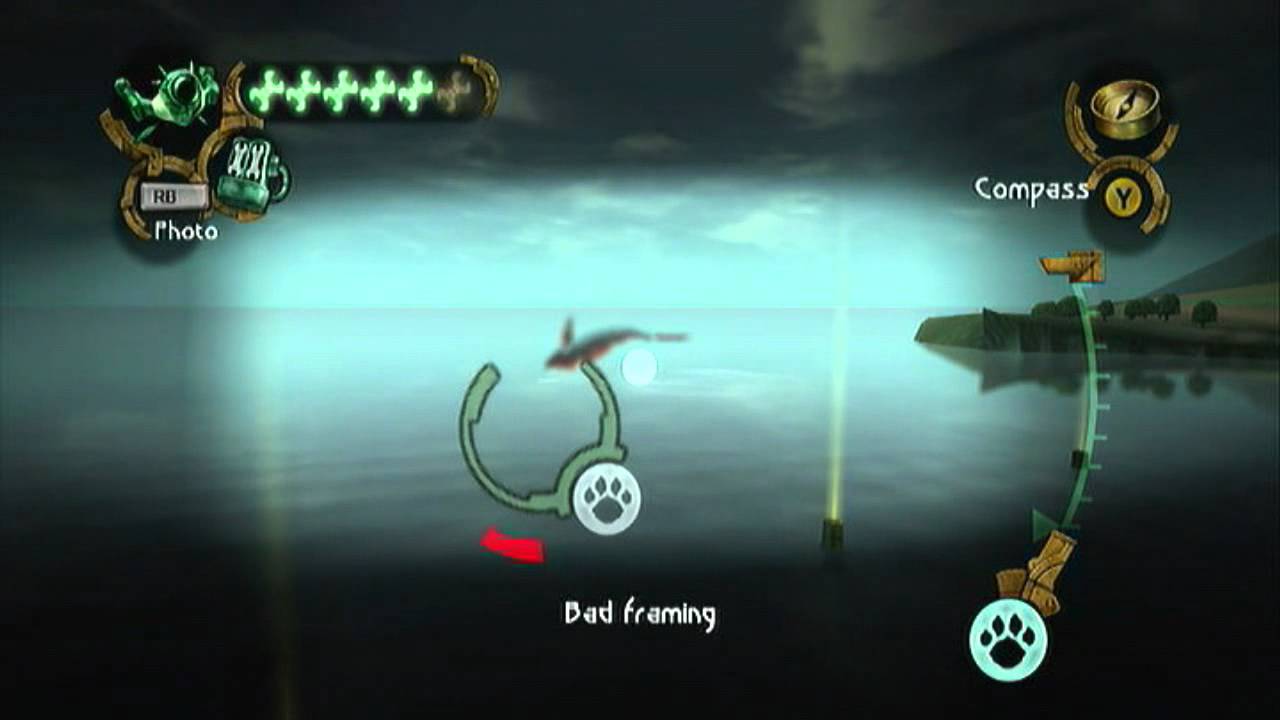
What must be understood about Jade is that despite her ability to kick ass with a staff or sweet-talk her way into getting what she needs, she is first and foremost a photographer. During the game, Jade finds herself collaborating with an underground organization of vigilantes called ISIS which promises to give her money in exchange for photographs of wildlife. Whether it's to upgrade your boat, weapon, or to increase your max health, you NEED money in this game, and sending pictures to ISIS is the easiest and most fun way to get it. Like I said, ISIS is particularly interested in photographs of the wildlife on planet Hillys. As a result, if at any point during your sailing from place to place, you stumble upon an unfamiliar breed of fish, it's up to you to whip out the kodak and snap a picture. Same thing with strange plants found growing on dungeon walls, imprisoned and weaponized dogs found in enemy bases, even the animal-like pedestrians found strolling about town; as long as it is living, a picture of it can be exchanged for money. 

     The thing that makes the ability to take pictures so ingenious is that it keeps Jade humbled and believable as a character; she is a photographer - that's part of her lore - and in order to play as a photographer, YOU, the player, must become a photographer. You need to wait for the right moment to capture the best angle of a bird, you become excited when you see a strange creature lurking around in the distance. Despite her taking on the responsibilities of an adventurer she never wanted to become, Jade stays true to herself, because no matter how many enemies she defeats and lives she saves, she is still a photographer at heart, and because the utilization of this feature is something that is required in order to make money, which is required in order to make progress in the game, this detail from Jade's lore is kept at the forefront of her character development. In this way, it is GAMEPLAY that directly influences the player's perception of her. We don't learn about Jade through any cutscene or dialogue, we learn about Jade by becoming Jade. 
      
     What Beyond Good & Evil has to offer is a gaming experience that tells an excellent story through excellent gameplay. Too often nowadays do we find games either whose story exists solely for the sake of the gameplay or whose gameplay exists solely for the sake of the story, but Beyond Good & Evil splits it right down the middle, offering gameplay and story that exist in order to emphasize the best points of each other. I give this game a very serious recommendation to all video game fans who crave side-quests, strong characters, tight combat, and solid dungeon-crawling. In other words, if you've ever thought that you wouldn't mind seeing Legend of Zelda re-imagined where everything is run by alien technology instead of magic, then Beyond Good & Evil is exactly for you.