So after a short hiatus from this blog, I have decided to resume my writing for a little while. Yesterday, I entered my school's lounge to watch one of my classmates play an old favorite of mine on the 72 inch TV. I watched this kid tear up the streets of City Escape and dive through Aquatic Mine and when he finally introduced himself, he and I started talking a bit about the Gamecube. Our conversation ended with me mentioning that I have 75 Gamecube games in my dorm room. He responded "Wow, you are a Gamecube MASTER if you have 75 games." Well that little fat dick was right! This one goes out to him.
What I noticed about his Sonic Adventure 2 experience was that it was unfolding via Steam - without a Gamecube controller. How could anyone resist playing a video game without the Gamecube controller if they have the option to?? The Gamecube controller is my favorite controller out of any controller I've ever used, and I've used a lot. My friends at home have invited me to share my opinions of the Gamecube controller with them, but I always feel bad because I knew my full opinion would be so long, that it would take up an entire blog post. So in honor of that kid in the lounge, and in honor of the new consoles and their controllers, whose generation pushes the Gamecube and its controller one generation further into the chasms of time, here we fucking go.
The Nintendo Gamecube Controller
How is it that despite the Gamecube controller celebrating it's 12th birthday this year, people still insist on using it to play games that are 5, 4, 2 years old? What is it about this controller, about its unusual button layout, its strange colors, and tiny D-pad that make it so loveable- make it rival with the XBOX 360's or PS3's beloved controllers? Well let's check it out.
Mkay so first to tackle the things that everybody knows: The Gamecube controller features one of the first wing-grip designs, was one of the first controllers to feature 2 thumbsticks and a D-pad, had 6 digital buttons (including the START button), and two shoulder buttons that each sported a hybrid of digital/analog technology. There are two things about the Gamecube controller that are unconventional, and I just mentioned one of them. Two features, two attributes of the Gamecube controller that brought it to the top of my list of favorite video game controllers. These two features that I am about to discuss make the Gamecube controller appear to some gamers as silly or even dumb and luckily for you guys, you have me to tell those people to fuck off.

The Gamecube controller doesn't have any new face-buttons, in fact, it has even less than the controller of the console that came before it, Nintendo 64, and the same amount as the controller that came before THAT, the Super Nintendo Entertainment System. It seems that the Gamecube controller didn't have any new amount of buttons, but it did sport a different, unparalleled layout. The Gamecube controller is the only controller ever made (I've ever seen or have been made aware of) that features one very large central button with 3 other smaller buttons arranged around it. As you can see in this diagram, the A button is the large center button, the B button is a smaller, circular button to the lower left of the A button, and the X and Y buttons are sort of cashew-shaped buttons above and to the right of the A button. Okay, fuck, everybody knows this. But does everybody know why? I mean, it makes sense: if there is one button that in the history of gaming has been traditionally used more often than any other button, why not make it bigger? Give it special treatment, because it is a special button. Fine. The A button is big because it is used most often.
So what about the B, X, and Y buttons? From here on out, this is my own theory for why the buttons are arranged the way they are. So if you are going to have a large A button, it would make sense that the other buttons are going to be sized with respect to how often the player is going to press the other buttons compared to the A button. With the Gamecube controller, there is no question that Nintendo was prepared to design their games to feature the A button as a means to activate the game's primary command. Let's look at Metroid Prime. Which action, out of Jump, Shoot, Fire Missiles, and Roll in a ball, each of the actions that can be triggered by pressing each face-button, do you do most often? The answer is Shoot. And which button is Shoot? A - the biggest button on the controller. Now. Which action do you secondarily, or the second most often? Jump. Jump is the B button. So now we see that secondary actions are mapped to the B button, but why B? What is so special about the B button when it seems that the X and Y buttons could just as easily be given the secondary role? Check this out, I actually have the controller in front of me right now. Assume that your thumb is going to naturally rest over the A button simply because it is the most comfortable position for the thumb to rest in. Now hold the A button down. Without removing your thumb from the A button, try

to tap the B, X, and Y buttons a bunch of times each. The button that is most comfortable to hit without removing your thumb from the A button is B, followed by Y, followed by X. Why? Look at the face-buttons from their sides. If you look closely, you'll see that the top of the A button is slightly rounded like a small hill while B, X, and Y have flat tops. Now look at the lowest point of the "hill" top of the A button. If, in your head, you drew an imaginary line continuing along the slope of the A button at the same angle and stopped your line as soon as it hit another face-button, you will notice something kind of crazy. The line you draw that hits the X and Y buttons strike those buttons on their side, not on their tops. The line you draw that hits the B button, strikes the B button on its face, not its side. So what does this mean? Well the lines I had you guys draw in your head are actually the paths your thumb travels in order to press B, X, and Y without releasing A, like I had you do before. If you are rolling your thumb along each of these lines, the lines that lead from A to either B, X, or Y, you will hit X and Y on their side and B on the top. Obviously, it is most comfortable to hit a button on its top, explaining why B the most comfortable button to hit without releasing A when it is being held down. It is also important to know that in order to maximize the comfort of "rolling" from A to B, the B button is set slightly deeper into the controller compared to X or Y, ensuring that you strike the B button on its face every single time you go to hit it.
I said that the Y button is second most comfortable to hit without releasing A. Why? Why not X?

Okay. Pangaea the shit out of these face-buttons and what happens? The X and Y buttons fit around the A button like a puzzle. The B button does not, but its circular shape makes it easier to fit onto the face of the controller, so that takes precedence over what I am about to explain about the X and Y buttons. Let's take the X and Y button separately. In your head, draw a line that connects the right side of the Y button to the right side of the A button. Then do the same thing for the left sides and color the 2 buttons and the space between them. You'll wind up with a mental picture that looks something like this image.
Look at your thumb. It's the same shape. What face-button command do you do THIRD most often in Metroid Prime? Fire Missiles. Y button. Second most comfortable to hit without releasing A. I know.
If you do the same thing with the X button, you get a slightly different shape that doesn't really look too much like anything. The best thing I could come up with is the following: The X button has the same shape as the right-most third of your thumb. If we cut your thumb vertically into thirds, the X button is about the same shape as the third furthest to the right. When you line up the X button with the X-button-shaped part of your thumb perfectly, you still have a whole bunch of thumb left over which sits directly above the A button. Push down, and you've got yourself your third most comfortable position for your thumb to rest in. What is your 4th most used face-button action in Metroid Prime? Morph Ball. X button.

So why make a controller whose face-buttons are all able to be pressed while holding A? Think about this: you have 4 actions that the face-buttons allow you to do. But what if you need to do 2 of them at the same time? Jump and shoot? Lock-on and Shoot? Accelerate and use items? Jump and Change weapons? These are all examples of typical actions that we need to perform at the same time or else we would be killed or lose the race or whatever SO when you position the buttons in a way that allows them each to be pressed comfortably without having to stop performing the main action triggered by A button, then you have a controller that allows you to perform multiple actions at the same time. But if this is the case, why don't other controllers use this layout? I mean, Gamecube is not the only home of games where it is necessary to perform 2 actions at once, so how is this done without the Gamecube controller's button layout? The answer is triggers. Triggers are pressed with the pointer or middle finger - not the thumb. 2 fingers to tackle 2 different buttons instead of the thumb to tackle 2 at once. That's why in Halo 3, Shoot, the first most important command is mapped to a trigger and Jump, the second most important is mapped to a face-button. With 1 finger to shoot and 1 to jump, jumping and shooting at the same time is easy. The Gamecube controller accomplishes the same exact thing in Metroid Prime, but without the trigger. In fact, the addition of the triggers on the Gamecube controller allow Samus in Metroid Prime to perform 3 actions simultaneously - Jump, Shoot with B and A respectively, and Lock-on with L. Impressive, no?

But what about those triggers? (This is the second function unique to the Gamecube controller) Push them down half way, and they glide the same way the XBOX 360 controller's do. Push them down all the way and they click. This is that digital/analog hybrid technology I mentioned earlier. Analog signals are used when triggers are pushed down on the XBOX 360. Gamecube uses the same technology, until the triggers are pushed down all the way and "click". This click, knocks an activator inside the controller that initiates a digital signal, also used by the face-buttons. This duality allows one button to perform up to 2 different functions. Light shield vs Heavy shield in Super Smash Bros. Melee or Run + Squirt vs. Stand still + Squirt in Super Mario Sunshine, maximizing the number of different commands available to the player without overwhelming the player with too many buttons.
And that's it! Gamecube controllers are awesome and that is why.

 Beyond Good & Evil - Nintendo Gamecube
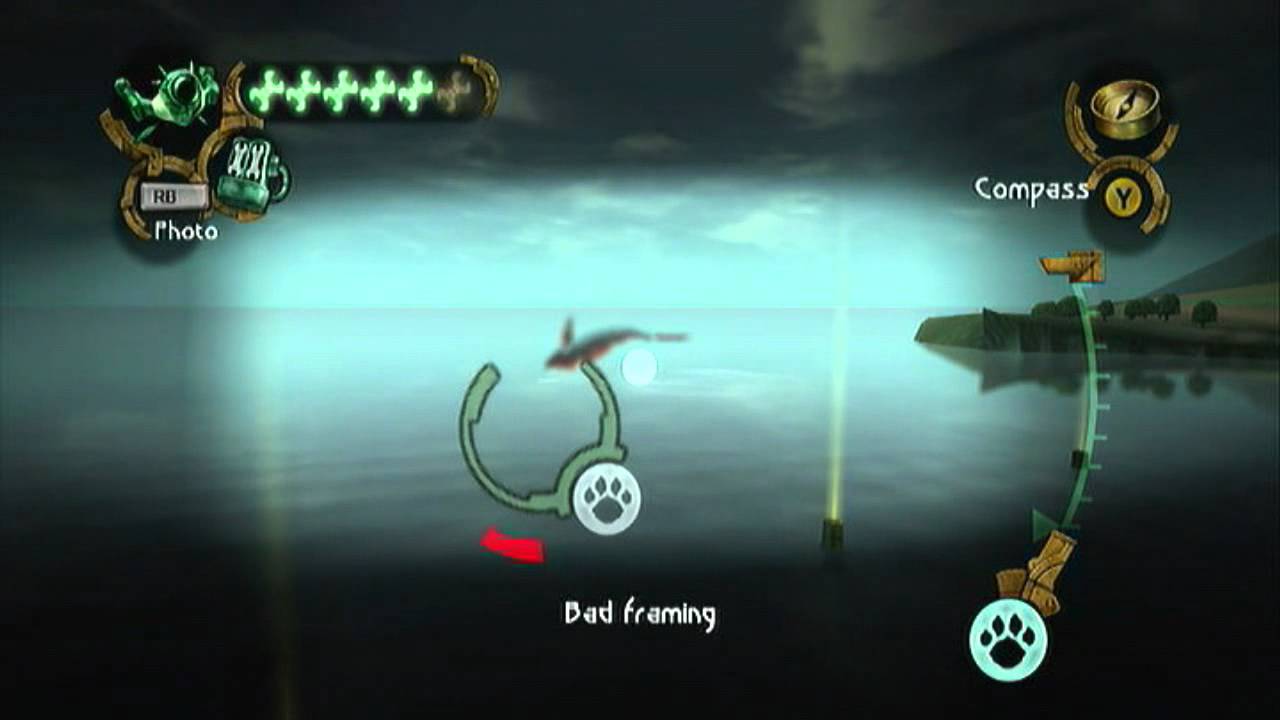
  The gameplay is most reminiscent of that found in a Legend of Zelda game, perhaps if Ocarina of Time was only 12 hours long. Your character, Jade, traverses the small open hub world of planet Hillys in a linear sequence of events and checkpoints which all eventually lead to you navigating masterfully crafted dungeons consisting of rooms that require you to solve refreshingly unique puzzles, defeat enemies using an extremely tight combat system, or sneak around all stealth-like without being detected. In addition to the expertly built dungeons, there exists hours of optional side-quests and games to play on the side should one decide to explore Hillys a little further. Planet Hillys is made up of a small sea with several islands jutting up from it's surface. Jade uses her motorboat to quickly zip all around planet Hillys in order to get from objective to objective. But whether you're going for a quick stroll through the bustling town, or sailing from dungeon to dungeon, there is always incentive for you to stop and explore. Mini-games can be found by talking to different residents of the central city, optional boat races are not only a blast to participate in but reward you with money which you NEED, and let's not forget the pictures you can take. OH the PICTURES you can take....