Nintendo Consoles

Nintendo Consoles
Showing posts with label gamecube. Show all posts

Thursday, April 14, 2016

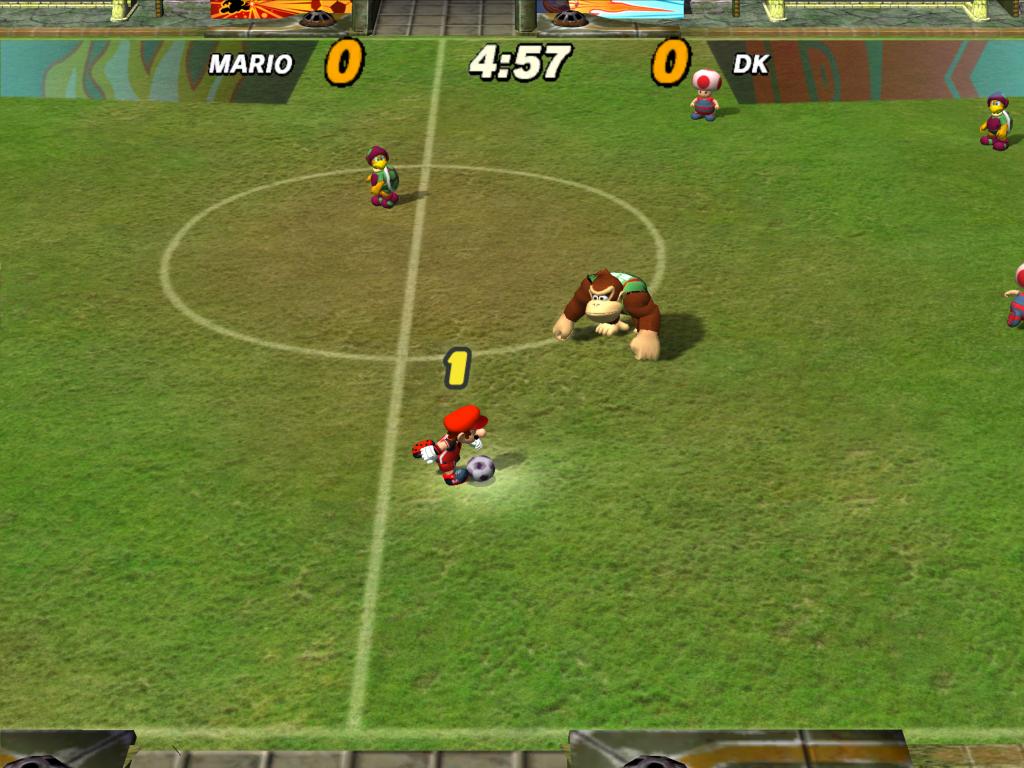
Super Mario Strikers

Super Mario Strikers - Nintendo Gamecube

Lists of top-ten best Gamecube games are usually comprised of about 9 first-party Nintendo titles, and Resident Evil 4. You always have Metroid Prime and The Wind Waker in the top 3, but after that I've seen Pikmin, Pikmin 2, Wave Race, Twilight Princess, Luigi's Mansion, etc. And sometimes, every once in a blue moon, hovering at around the 9th or 10th spot is a third-party title featuring first-party characters shoving and checking each other in pursuit of a soccer ball. This title is Super Mario Strikers.

Super Mario Strikers is a soccer game with slight modifications to the traditional rules of the international sport. The goal is still to kick the ball into the net of the defending team, but this wouldn't be a Gamecube game without some re-imagining of sorts; Super Mario Strikers is the only Mario-sports game I can think of to place this much emphasis on violence. During a match, you are encouraged to switch back and forth between each of the 4 players on your team to score as many points as possible. Normally this would mean good teamwork and skilled playing, but Strikers cares much more about the instant-gratification that comes with punching and slide-tackling your opponents than it does about adhering to classic soccer techniques. It's super fun and easy to knock the members of the opposing team into the electric walls surrounding each soccer field, and combining these attacks with Perfect Passes, Super Strikes, and dekes is the best way to ensure you have an extremely exciting Mario soccer match.

The main issue with Super Mario Strikers is the dearth of variety between game-modes. There are Cup Battles, Super Cup Battles, and Grudge Matches. Cup battles are your beginner-level single player mode. Beat all the cups, with the teams (in this mode) set to Rookie difficulty, in order to unlock Super Cup Battles. Super Cup Battles are the same thing with higher difficulty, and beating each of these tourneys unlocks different "cheats", such as Field Tilt and Explosive Power-ups, to be used in Grudge Match (man, remember cheats?). Grudge Match is simply your multiplayer mode, where up to 4 people can join in on the gnarly soccer fun. This being said, your friends can actually drop in and out from game to game to play all of the single-player modes Co-op. Each Cup can last anywhere from 5 to 15 matches total, so it's really nice for a friend to be able to join in for 3 or 4 matches, then drop out without having to change modes or exit menus or anything. The point is that completing the single player modes awards nothing more than enhancements to the multiplayer experience. This makes Strikers a perfect party game, but very little more- it just doesn't have enough content to hold up as a single player experience.

The unlockables in Super Mario Strikers, not including the cheats, also leave something to be desired. There are 9 playable teams in the game, and only 1 of them has to be unlocked by playing Cup Battles. You will also unlock different stadiums by completing certain cups, and although I do have my preferences now that I've unlocked them all, each are barely more than color-swaps, and none of them change the gameplay at all.

Super Mario Strikers is sincerely addicting. Even in the single player modes, you can adjust the length of any match to be 2 - 15 minutes, making them an awesome way to kill 15 - 20 minutes. It's also a great game to liven-up a party, or just hang out with a couple of friends and some snacks on a Thursday night. Unfortunately, Strikers suffers the most when those friends leave and all you've left are the single player modes. Playing the game alone is fun for a little while, but when a title is this silly and this violent, it can have the tendency to leave you with an itch that can only be scratched by shoving your friends into electric walls. If you have friends to play this game with and you collect for the Gamecube, buy Super Mario Strikers; if not, don't.

Thursday, March 31, 2016

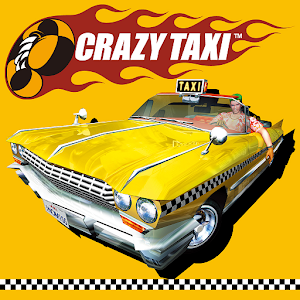
Time To Make Some Crazy Money!!! - Crazy Taxi

Crazy Taxi - Nintendo Gamecube

Crazy Taxi is one of those games you see almost everywhere. Whether it's taking its original 1999 form in an arcade, waiting to be downloaded on Steam, or enjoying life on any of the sixth generation consoles, Crazy Taxi is nothing less than a classic title screaming with personality. I find this game, with its dumb yellow box, at retro game shops and flea markets everywhere I go. Usually a single copy will be accompanied by a second and third and fourth just sitting on the shelf unwanted, bearing a humbling $5 price tag. I recently grabbed a copy to use its box to brighten up the aesthetics of my Gamecube collection, but instead I found myself hooked on burning rubber.

Even on consoles, Crazy Taxi still retains its arcade feel. Gameplay involves picking up and dropping off passengers on the streets of what appears to be an exaggerated, cartoon version of San Francisco. You are free to drive around the town, disobeying all traffic laws, flying over sidewalks and off of truck-beds, but time will quickly expire if you neglect to pick up pedestrians waiting for a taxi ride. Both taking on and unloading passengers will award you additional time, and the game ends when time runs out. That's pretty much it. The console version keeps track of your high scores, and as long as you're playing the "Arcade" or "Original" version of the game (selected on the main menu), achieving a respectable high score is all there is to it.

The console version also has a challenge mode. Challenge mode presents players with different scenarios, such as seeing how far you can launch off of a ramp, or how quickly you can escort a certain number of passengers. Gameplay stays pretty uniform no matter which mode you play, but challenge mode does its best to mix things up, sometimes successfully and other times just adding more of the same.

The best way to play Crazy Taxi (in my experience) is to put it on if you have 10 or 15 minutes to kill before you need to go to work or something. As many times as I have booted Crazy Taxi since I purchased it 3 days ago, I haven't yet played for more than 20 minutes at a time- this is not a game meant to be played for hours and hours at once. That being said, it is addictive and the punk-rock soundtrack featuring early hits by The Offspring is an excellent compliment to the fast-paced bad-ass attitude the game proudly demonstrates.

Don't get me wrong, Crazy Taxi isn't going to change anyone's life. But it is really fun and undoubtedly worth $5. I recommend this to anyone who is looking for something dumb to bust out at a party, or to anyone whose video game box collection is severally missing the color yellow.

Sunday, January 24, 2016

Madagascar...DUH.

Movie tie-in games are legendary for providing gamers with mediocre non-canon, filler, or just plain garbage. Children's games are known to be occasionally fun, but usually go unconsidered. Low expectations can often precede impressive surprises, but what happens when you have a movie tie-in that takes the form of a children's game? Usually mediocrity. But is this the case with one of the many games I have owned for years but up until recently never had the interest to play?

Madagascar - Nintendo Gamecube

Yes, this is totally the case. Madagascar is really mediocre. I mean, duh, right? It's a "kid's game". But I wanted to play this game after noticing that I had no idea what made kid's games bad. I don't remember disliking kid's games as a child, yet I no longer play them as an adult. Why? Let's find out.

(for real) Madagascar - Nintendo Gamecube

Madagascar the video game, based on the Dreamworks movie of the same name, is an action-platformer that combines many different types of gameplay into one coherent title with a strong emphasis on plot and surprisingly little to no repetition. The main game is broken up into levels that take anywhere from 10 to 20 minutes to complete. The levels are easy, and there are only enough to make up what comes out as a 4-5 hour game, but each level introduces one or more additional mechanics that keep gameplay fresh, yet never stop it from becoming boring. Each level has you playing as one or more members of the cast of the Madagascar movie, and the dialogue (as well as the entire game, for that matter) does not assume that the player is already familiar with the source material.

The constant switching of characters contributes largely to keep the gameplay fresh. Each of the 5 characters you play as have enough of the same moves in common, such as jump or attack, to ensure a smooth transition from character to character, but have enough unique moves to justify the transition in the first place. Levels are designed around the moveset of each character used to complete them: Alex with his double-jump ability is featured in many of the levels that focus on platforming, Gloria with her large collection of attacks is featured in levels that emphasize combat, etc.

The problem is that while the gameplay is varied, it is simple and unrewarding. The issue with these kids games is that while they are not particularly offensive on their own  (aside from some hilariously bad graphics and unpolished optional mini-games) there is nothing satisfying about playing them.

Of course the argument would be made that no kids game could satisfy the needs of an experienced adult gamer, but I would be very quick to disagree. That which is known as a "skill-cap" is the amount of time or practice that must be devoted to a video game in order to master it as thoroughly as possible. If a game has a high skill cap, then it can be said that the game requires a lot of practice and/or time to master it, while a game with a low skill-cap may require virtually no practice in order to achieve mastery status. Satisfaction in video gaming comes with having achieved mastery despite a high skill-cap. Some games have a high skill cap despite being easy to play- this would be an example of "easy to play, hard to master", a phrase that adequately describes many titles. Many kids games are "easy to play, hard to master", but Madagascar is not one of them, and thereby scratches no itch.

Kid's games can be fun under particular conditions. I am familiar with many kid's games that become more fun as knowledge of their nuances is gained, but Madagascar is not an example of such a title. Though not particularly lazy in any one department, it does not pose enough of a challenge, nor does it possess a high enough skill cap, to yield a satisfying victory.

Monday, December 28, 2015

A Retrospective: Guitar Hero

I ventured a bit around Long Island today with a couple of my friends to our favorite video game
stores. One of our destinations was a retro video game shop called Video Game Trading Post, and it is incredible. It is just the tiniest bit out of the way of my usual hangout spots, but they have an extremely impressive quantity of quality games, as well as several walls filled from floor to ceiling with hilarious amounts of rubbish. It was while browsing the towers of garbage games and shovelware did I find a title about whose existence I had either once completely neglected or have since completely forgotten: Guitar Hero 5.

So I bought Guitar Hero 5 for the Playstation 2, but it was also released for the Wii. So there you go- we are still talking about Nintendo consoles if you're willing to use a bit of imagination for this post.

I played Guitar Hero 5 Career Mode for a bit, perhaps for a couple of tiers, then I went over to Quick Play mode and played a set of songs (all of which were unlocked without me finishing the Career Mode), and then I turned it off. Did I have fun? No, not really. But of course, the question is "why"?

Guitar Hero used to be incredible. It took the video game world by storm a good 10 years ago, but it was a fast-fading trend, and even it's attempted "revival" this year wasn't enough to rekindle interest in the rhythm-based franchise. The reason it stopped being fun is actually pretty obvious, especially for someone who has been with Guitar Hero since the near-beginning, but before we can answer that question, we first must identify exactly when Guitar Hero stopped being fun, look at the game that began the decline of Guitar Hero, and identify just how it influenced the future of the series' installments.


So here we go:
The game that began to ruin the Guitar Hero franchise was Guitar Hero 3.

Despite the currently (or once-currently) mass appeal of Guitar Hero 2, Guitar Hero 1 and Rocks the 80's were pretty niche for their time, and not very popular. In fact, Guitar Hero 1 and Rocks the 80's were hardcore games. They were challenging, and felt like the developers approached their creation from a gamer's perspective as opposed to strictly one of a music-lover. The games had solid difficulty curves, didn't insult the players by cheating them out of the experience they expected, and certainly offered gamers something new. Guitar Hero 2 was a sequel the way sequels are supposed to be, featuring proudly its improvements to the original game, hosting not only a larger quantity of songs, but a greater quality of songs when compared to that and those of the original title. Still, the difficulty curve was like that of a traditional video game: beginning easy and ending difficult, with each victory having felt earned, as opposed to grinded out. It is important to note that Guitar Hero 3 DID retain the same feeling, pacing, and tone that appealed primarily to gamers seen from Guitar Hero 1 to Rocks the 80's, but while it was Guitar Hero 2 that made the series popular, it was Guitar Hero 3 that made the series famous, and once you become famous, everything starts to die.

Each iteration of the Guitar Hero series following Guitar Hero 3 felt like games that were created not for art, not for experimentation, not even for the gamer, but exclusively for the studio to get more money. The design elements that made Guitar Hero feel like a traditional video game were completely removed from all Guitar Hero games following GH3. Up until GH3, the Guitar Hero franchise was responsible for delivering to me not only really fun gameplay, appealing to the gamer within me, but really good songs and music, appealing to normal person (deep) within me. There was a balance created by a development studio who knew that Guitar Hero was a video game first, and that gameplay could not be compromised if the title was expected to be fun. Guitar Hero 5's content is weak, man. There are a few good songs, but nothing about the game makes me want to play more. The personality and charm of the cartoonish graphics, awful covers, and sense of humor seen in the first games has given way to that which appeals to the masses: blink-182 songs in the line-up, long hammer-on sections that look difficult but are actually insultingly easy, lifeless venues, GOOD SONGS WITH BORING NOTE CHARTS, no context, no reason to even play the Career Mode since every song is just given to you from the start of the game.

Guitar Hero 5 reminds me of parents who just give their children what they want without asking if what the kid wants is actually good for them. Want more Guitar Hero? There you go: Guitar Hero 5. And yeah, fans who asked for a new Guitar Hero got what they asked for, but how does it feel? Does GH5 feel new, or earned, or valuable, or does it just feel like more of what you already have? Does it feel redundant and insulting, making you realize that while there exists an endless ocean of quality video games spanning 30+ years across multiple generations of artistic and technological experimentation, you've spent another $50 dollars on something you basically already own, albeit an inferior version? Do you feel like a chump who has sold your soul to a company that doesn't care about you unless you have money?

Guitar Hero 1 - 3 felt like an experiment gone wonderfully right; it started a little shaky, definitely strange but certainly suggesting potential. Guitar Hero 2 improved everything that had to be so. Rocks the 80's was essentially a DLC pack, but the songs were fun to play and fun to hear, as well as respectful of a gamer's-type difficulty curve and pacing, and Guitar Hero 3 was the series perfected with the best soundtrack, graphics, and gameplay the series has ever seen. But Guitar Hero 3 was too good. Guitar Hero 3 was the game that made the developers realize that they no longer had to respect their fans because the fans no longer respected themselves. Once it became clear that everyone everywhere was going to buy Guitar Hero no matter what, the developers didn't feel it was necessary for them to try anymore. In other words, once the fans stop putting pressure on the developers to make a better game, developers stop putting pressure on themselves to make a better game, and when that happens, you get Guitar Hero 5: the last few drops of water wrung out from a now-damp towel that once contained viscous, french-vanilla creams of originality, creativity, and video game art supremacy.


Monday, December 21, 2015

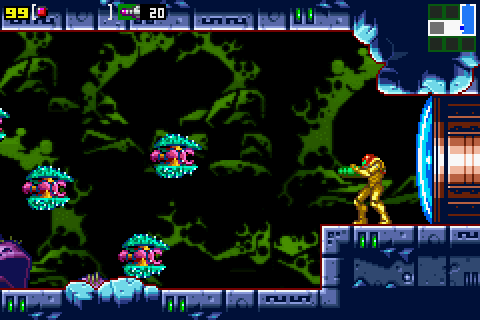
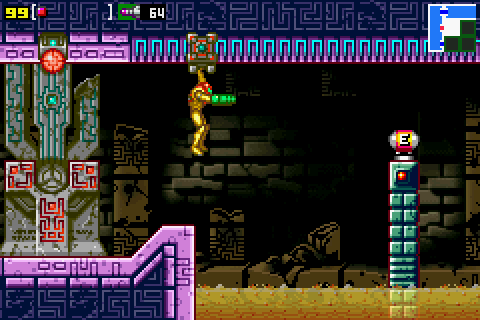
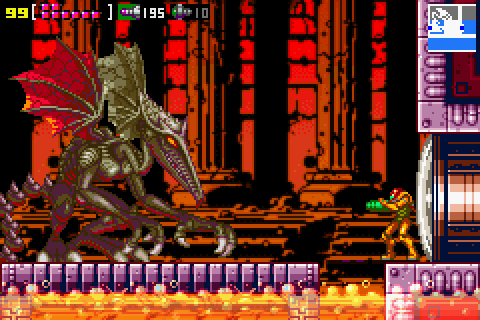
Metroid Zero Mission

Metroid Zero Mission -
Gameboy Advance 

In the year 2004, two years after the series' debut on the Gameboy Advance with Metroid Fusion, we received a game that would not only be the second Metroid title on the Gameboy Advance, but many gamer's second chance to experience the Metroid series in its original capacity. While Metroid Zero Mission is technically a remake of the original Metroid released on the NES in 1986, it certainly has no problem justifying its own existence. Updated graphics along with the original Metroid in-full now being literally in the palms of your hands are nice touches, but careful consideration must be made when reviewing this retouched game; does the original Metroid still hold up even with meticulous updating, or is this one classic better left back in the 80's?

The story, as is the case with many Metroid games, is easy to understand. Our protagonist, Samus, is sent to Planet Zebes in order to annihilate the mechanism being used by opposing space pirates to build super weapons. With the exception of a few cutscenes added in order to update the feel of the original (at that point) 18 year old game, Metroid Zero Mission pretty much leaves you to explore on your own. Those who have never played a Metroid game before should have no problem entering the series via Zero Mission, as multiple difficulty levels are available to select right from the start, and even on Normal difficulty, the game isn't too challenging.

The difficulty usually associated with the Metroid series stems from the player lacking the intuition necessary in order to figure out where in each of the game's 7 (later, 8) worlds they must explore next. Navigating each room in each environment is simple enough, and the map, upgrades, and new abilities come with the exploration, along with the opportunity to uncover secret passages that more often than not will lead the way to the next area or even to supplementary power-ups such as an increase in missile-storage capacity, or health buffs. Updated graphics borrowing assets and art design from Metroid Fusion are extremely successful in bringing life to the once aging world of Planet Zebes. Hardware limitations of the Gameboy Advance seemed to be no hindrance at all while designing Metroid Zero Mission; from start to finish, Planet Zebes is an absolute pleasure to explore.

Often if a game is too easy, it can become boring. Then again, if a game is too challenging, it can become discouraging. Despite Metroid Zero Mission being a little bit on the easy, and while I'm at it, short side, it does not lack any bit of the magic that gamers have come to expect from other Metroid games. Initially, the map sizes of many of Zero Mission's environments, such as Norfair or Ridley, can feel intimidatingly ambitious. While "intimidating" can often mean "discouraging", as it does in many other games, Zero Mission finds a way around this through building up the confidence of the player by building up the strength of Samus. Small power-ups, such as the Charge Shot, Missiles, Super Missiles, and Morph Ball just to name a few, are awarded frequently, and the types of power-ups obtained are never too similar to the power-up most recently acquired. Missiles and Super Missiles are acquired at opposite ends of the game, as are Morph Ball and Power Bomb, as well as many other similar upgrades. This rapid change in arsenal often supports rapid changes in scenery; if you've just acquired a new weapon, you can expect a new type of area, thus a new type of gameplay.

Unlike most modern Metroid games, Metroid Zero Mission only features 3 boss fights, which is 1 more than the original featured. While Zero Mission does involve a great deal of combat, from blasting small nuisances of enemies to bringing down both Kraid and Ridley, the environments prove themselves to be much more threatening than any monster, especially in the later 20% of the game. Often, the way forward will be shown on the map, but left purposely unclear in the world. Using every weapon to try to blast through every wall in the hopes of revealing a hidden path is a habit that all players of Zero Mission will get into, and even still, will often finish the game far from 100% completion.

Though an average playtime of Zero Mission will probably only last around 3-4 hours, there is plenty of content to be enjoyed after the initial play-through is completed. Finishing the game once will not only unlock Hard mode, but will unlock the original Metroid game which can be played by selecting it in the Options menu. Inputting a certain sequence of buttons on the Options menu of a game file after having completed Normal mode will also unlock Time Attack mode, which will time how quickly you can complete 1 play-through on Normal difficulty.

Metroid Zero Mission is short, being only a little bit longer than the original because of an extra chapter exclusive to this version, and it can be easy if played on Normal or Easy difficulty, especially if this isn't your first Metroid game. Despite this, Metroid Zero Mission is excellent. Everything from the graphics to the tone to the pacing is absolutely wonderful, and the life exuding from Planet Zebes' environments serves as a praise-worthy example of how hardware limitations can be over-come through clever art and carefully considered level-design. Whether you originally played Metroid back in 1986, or have never considered playing Metroid before, Metroid Zero Mission is not only a perfect example of what this series has to offer, but a perfect example of how fun timeless game design can be.

Sunday, November 22, 2015

Sonic the Hedgehog

I'm bored! Let's talk about Sonic the Hedgehog.

Sonic the Hedgehog

Throughout the 30+ years of significant gaming history, the video game world has seen its fair share of console mascots. Between Super Mario, Ratchet and Clank, Spyro the Dragon, and even Pac-Man, perhaps no video game mascot has left a legacy as impressively dramatic as Sonic the Hedgehog. It's no question that Sonic the Hedgehog has fallen off in recent years, but if there is seriously only one thing that my readers know about me, it's that I love Sonic.

I haven't played all of Sonic's tales, but I've played enough to give an interesting top 5 favorite Sonic games. First though, allow me to list what I have played:

Sonic the Hedgehog (Mega Collection)

Sonic the Hedgehog 2 (Mega Collection)

Sonic the Hedgehog 3 (Mega Collection)

Sonic & Knuckles (Mega Collection)

Sonic 3D Blast (Mega Collection)

Sonic Spinball (Mega Collection)

Sonic Adventure DX Director's Cut (Ported to Gamecube)

Sonic Adventure 2: Battle (Ported to Gamecube)

Sonic Advance 2 (GBA)

Sonic Advance 3 (GBA)

Sonic Heroes (Gamecube)

Shadow the Hedgehog (Gamecube)

Sonic Riders (Gamecube)

Sonic the Hedgehog 2006 (Xbox 360)

Sonic Unleashed (Xbox 360)

Sonic Generations (Xbox 360)

Sonic Generations (3DS)

Sonic and the Secret Rings (Wii)

Sonic Riders Zero Gravity (Wii)

Sonic and the Black Knight (Wii)

Sonic Colors (Wii)

Sonic Rush (DS)

Sonic Lost World (WiiU)

Sonic Boom Shattered Crystal (3DS)

These are games that I have not necessarily beaten, but games of which I have played enough to understand thoroughly.

Number 5Sonic Colors 
By the time Sonic Colors was released for the Wii, Sonic fans had already endured the disappointing quality of both Sonic and the Secret Rings and Sonic and the Black Knight for the Wii. We took the announcement of a new Sonic game with copious amounts of salt, but Sonic Colors turned out to be an expertly crafted Sonic game, reminding us first and foremost that above all else, Sonic is meant to go fast. While very much on the short side of games, clocking in at about a 4 - 6 hour Main Story, Sonic Colors introduces new abilities that change up the typical Sonic rhythm without changing the typical Sonic feel.

Number 4: Sonic the Hedgehog 2
I didn't grow up with a Sega Genesis. My first Sonic the Hedgehog game was Sonic Adventure 2: Battle, and it wouldn't be until I was perhaps 10 years old would I learn what Sonic once was. Thanks to Sonic Mega Collection on the Gamecube, I was able to experience all of the classic Sonic titles that came before my time. Among them, Sonic 2 shines the brightest. The levels are more open and faster than those in Sonic 1, and aren't as difficult for younger gamers as they are in Sonic 3. For me, Sonic 2 is a perfect side-scrolling platformer.

Number 3: Sonic Heroes 
I didn't love Sonic Adventure 1 or 2 for the stories, I loved them for the characters. Though most Sonic fans eventually came out to admit that they disliked most of Sonic's friends, I was not part of that crowd. I love Sonic's friends, and Sonic Heroes puts each of them front and center. Sonic Heroes allows you to control a team of 3 Sonic characters at a time, while opting to exclude a vast story in favor of simple gameplay on ingeniously designed levels.


Number 2: Sonic Adventure 2: Battle
The Sonic game that started it all for me. Not only did Sonic Adventure 2: Battle have profoundly fun gameplay, it had a killer story and introduced Shadow the Hedgehog: briefly the most popular Sonic characters of all time. Sonic Adventure 2 has everything that makes a game good: gameplay that varied from level to level, cool characters, and a surprisingly deep and emotional story about revenge and nature vs. nurture.

Number 1: Sonic Unleashed 

It is very difficult for me to explain why I love this game. My best college memories have come from playing this game, as one of my best friends on campus and I once spent an entire semester trying to 100% this game, and succeeded, but that isn't the only reason why I love this game so much. Sonic Unleashed had everything Sonic Adventure 2: Battle had (barring Chao), and shot it up with crack-cocaine and adrenaline. Sonic Unleashed features Sonic at both his fastest and his slowest. Different levels become available depending on whether it is night or day time, and while the night time levels feature Sonic playing God of War-like levels, the day time levels are literally the fastest in any Sonic game. They are difficult, but the excitement of completing one of the lightening-fast levels with an S rank is one of the most rewarding feelings I have ever gotten from a video game. Sonic Unleashed made me want to play better, explore the levels for shortcuts, slow down to perfect combos and then speed those combos up. Combine that all with some of Jason Griffith's best voice acting, and some of the best music in any Sonic game, and you have Sonic Unleashed: one of my favorite games of all time.

Friday, November 6, 2015

Custom Robo

It's been a long time since I last reviewed a hidden gem on the Gamecube. To be honest, it has been a long time since I last started a new Gamecube game. A friend is letting me hold onto a few of his games for a while though, so I figured a few weeks ago was a perfect time to dust off the ol' cube and get back to what brought me here in the first place.

Custom Robo - Nintendo Gamecube

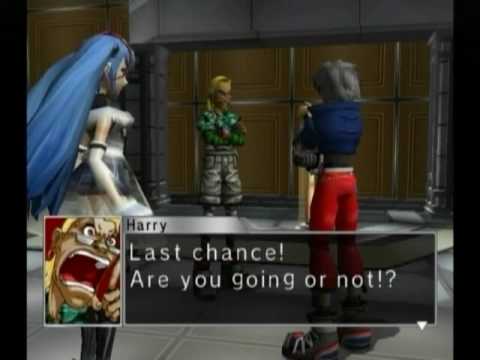
      It's not too often that we see an IP with five entrees slip under the radar to the extent that Custom Robo has. Spanning all the way back to 1999 on the Nintendo 64, the Custom Robo series was initially one that was kept exclusive to Japan, with its first three entrees, Custom Robo, Custom Robo v2, and Custom Robo GX never to see an international release. Eventually, North America got its first taste of the Custom Robo series in the year 2004 on the Nintendo Gamecube. For a retro game, Custom Robo has a pretty considerable price tag, sitting at around $25 on eBay at time of writing, but is Custom Robo still worth a 3-Way or Vertical shot, or has it rusted over time?

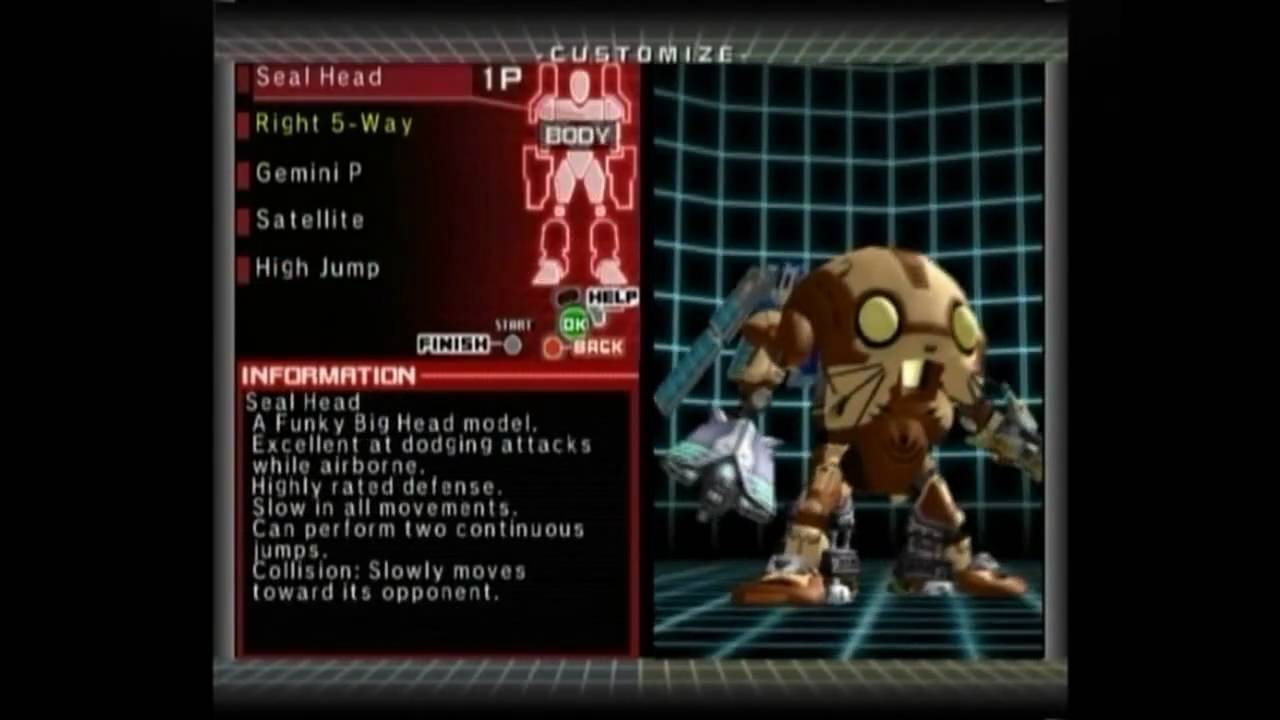
   At its forefront, Custom Robo is an action RPG. Most of the gameplay takes place in 3D battle arenas where either two or four Custom Robos will fight in order to reduce their opponent's health from 1000 to 0. The way to gain the advantage over your opponent is by taking the Robo that you are given in the beginning of the plot and upgrading it using parts you are awarded by completing certain tasks as you progress through the initial 10 hour campaign. Things start off pretty simple while you have few parts to select or swap-out, but quickly become much more interesting as you are awarded many different parts frequently. Each Custom Robo is made up of a combination of 5 parts: gun, bomb, pod, legs, and model. Most of the parts are so vastly different from each other that even the most subtle changes to your build can produce drastically different results in the battle arena. I experimented with a few different builds to find one that fit my playing style, and in the process played briefly with a Custom Robo that did heavy damage and jumped really high but lacked mobility and was armed with a 3-Way shooting gun and heat seeking missiles, and another Robo that was extremely agile and powerful while in the air but lacked fire power on the ground, equipped with triple-pods designed to meander around the battle field, before I finally built the perfect Robo for me: a Robo with the ability to warp while in the air, armed with a gun that shoots both forward and up, pods that could be fired three at a time, and bombs that cleared walls.

   
  Being able to quickly master the layout of each arena is another noteworthy albeit much less important skill to have when fighting. According to the lore, each battle arena is generated by natural abilities had by each Custom Robo master, and whenever you fight a new opponent, you play in their arena. Each arena stays roughly the same size, and the differences between each one can be a bit underwhelming, but the diversity in color scheme and music, as well as noticing how the layout of each arena reflects the personality of the character generating it makes what could have been an afterthought on behalf of the developers one of the most charming aspects of the game.

    The story is much less intricate than the building and fighting of Custom Robos, though it is not without its plot-twists, fun characters, and genuinely humorous dialogue. After selecting the name of your character, you wake up in your home and are immediately encouraged by your land-lady to pursue a job as a mercenary working for an organization called the Steel Hearts. You get the job after proving your natural talents with a Custom Robo by fighting off enemies from a rival gang called Z Syndicate who failed in an attempt to rob a nearby laboratory of a rare Custom Robo model. Without wishing to give anything more than the first 5 minutes of the game away, you eventually learn what/who it was that the Z Syndicate is after, as well as who runs the Z Syndicate. Overall, the story, while cute and necessary in order for some of the hilarious dialogue to hold meaning, does little more than serve the gameplay.

 
  After all of that, there is a second story mode that is unlocked after completing the first. The second story mode throws you and your fellow Steel Heart members into a tournament meant to have the citizens of the town regain the trust of the police after it was lost as a result of the events in story number 1. While I found the entirety of the first story to be extremely easy albeit fun, the second story provides a much greater challenge. As opposed to the fights in the first story won by selecting the same build and using the same strategies every round, I found myself having to use different parts and tactics in order to account for the game's increased difficulty level. In story number 1, I felt discouraged from using different parts after I found a build that worked perfectly for me, but the increased difficulty provided by the second story was exactly what I needed in order to explore the game's depths to further extent, and I wasn't disappointed.

     At the end of it all, the gameplay is divided into two parts: 1 where you walk your character to which ever location on the map triggers the next plot point, and 1 where you actually fight. Throughout all of Custom Robo, there are no puzzles, no exploring, and no level-up system besides the acquisition of new parts. While the fighting is addicting, I did become concerned that the lack of variety in gameplay would result in the game feeling samey. However, since the game is so short, with my completing of the first story taking a shade under 10 hours, it ends before you get tired, and while I will always appreciate a game for not over-staying it's welcome, it would have been nice to see more variety.

    Custom Robo is uncompromising in its gameplay; it is an action RPG about building robots and using them to fight other robots. Its arcade-like and campy tone is refreshing and has aged well. Despite some gameplay repetition and a generally weak story, Custom Robo offers an impressive level of depth when it comes to selecting your build, and features an addicting battle system that will be sure to keep you coming back even after your last opponent has fallen.


Friday, April 4, 2014

For No Reason At All

Sometimes, you just like a game for no reason. No reason at all. This usually happens when the game is mediocre at best, because let's face it, if the game was good, you'd have a reason to like it. Games that you like for no reason usually just have something about them that appeals to you and only you. For example, Yu-Gi-Oh! Eternal Duelist Soul is one of my favorite games for no reason at all. I love Yu-Gi-Oh!, and so you'd think that I would prefer the latest Yu-Gi-Oh! game over an old one, on account of it having the greatest variety in cards, but no - this one is special to me. For some reason, I just think that it is awesome. So what does this mean for the blog? Well, I can't really write about my opinions of a game if I can't justify them, so here is a list of games that I like for no reason with a brief description of why I might like the game. Of course, these are all Gamecube games:

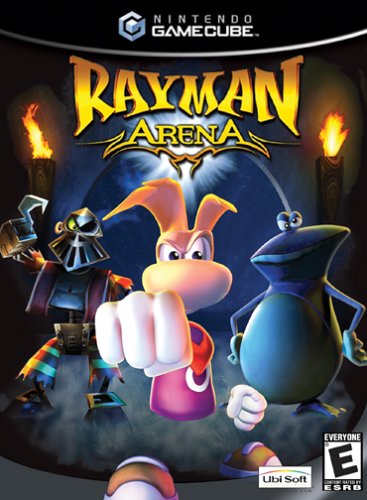
Rayman Arena - This wacky game involves Rayman and his pals either fighting or racing. The fighting mode in this game takes place in a 3D arena similar to like, Custom Robo or Gotcha Force. The goal is to defeat your opponent using power-ups to deplete your opinion's health as many times as possible before time runs out. This really isn't as fun to me, though, as the racing mode is. This racing mode feels a lot like Sonic The Hedgehog meets Crash Bandicoot where you try to complete 3 laps around the large, fully 3D "track" before your opponent does. The environments of the tracks vary greatly from lava factories to dusky beaches, while the platforming and sense of speed just feels good. Allow me to point out that this racing is done on-foot. This is a great multiplayer game, but it is also just a silly game to check out on your own.


Extreme G3 - This game is hard. I actually can't even beat the first circuit of this futuristic racing game. The goal of this game, like all racing games, is to complete however many laps and cross the finish like before your opponents do. However, this motorcycle futuristic racer involves just as much combat as it does speed. Each bike can be upgraded and fitted with guns, bombs, and many other weapons for you to use to take out your opponent and possibly destroy his bike before he can finish the race. This game is hard, but really satisfying.


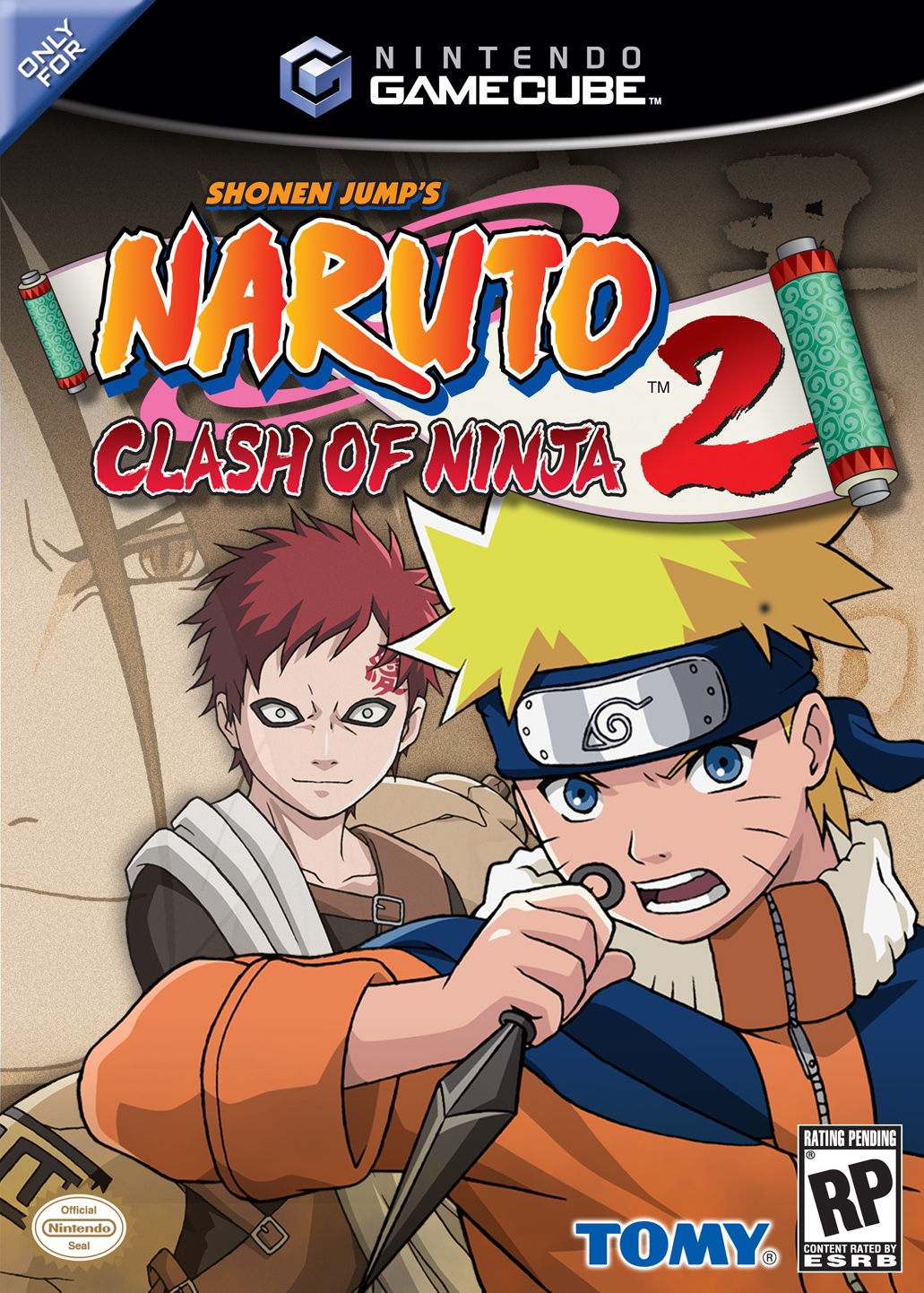
Naruto Clash of Ninja 2 - This is just a Naruto fighting game. I have this fixation on good sound effects as I have found that they can really add to the satisfaction that comes with punching someone in the face. Sometimes a good "thud" can be just as sensually stimulating as the image of watching a fist collide with a face, or in this case, kunai colliding with shuriken. The audio in this game is amazing. Naruto Clash of Ninja 2 is a fighting game that takes you through the story of Naruto the anime series up until a certain point. You can chose whether or not to care about the story, but the fighting just feels good. The controls and camera are good and the arenas are fully 3D with a lock-on as opposed to the 2D feel that fighters such as Tekken or Mortal Kombat can have. It isn't really complicated enough for hardcore fighter fans to be satisfied by, but it is accessible and easy to pick up if you're looking for something simple, yet rewarding.

Ultimate Spider-Man - Oh boy, I love Spider-Man games. Somehow, they are just so consistently good. This game has you playing as the web-slinger himself as you swing through the city taking out bad guys by exploring the open world while adhering to the story of Peter Parker who's best friend had turned into the other playable character in this game: Venom. This game has you switching back and forth between Spider-Man and Venom as the day turns to night, and night turns to day. Now, time does not progress on it's own, you do have to essentially just sequentially beat every mission the game throws at you in order to move forward in the game, but it doesn't take away from the fun. This game isn't long, nor is it's size as impressive as that of Spider-Man 2 the video game, but it is a certainly a fun game with a lot of
humor recommended if you're looking for something short and sweet.


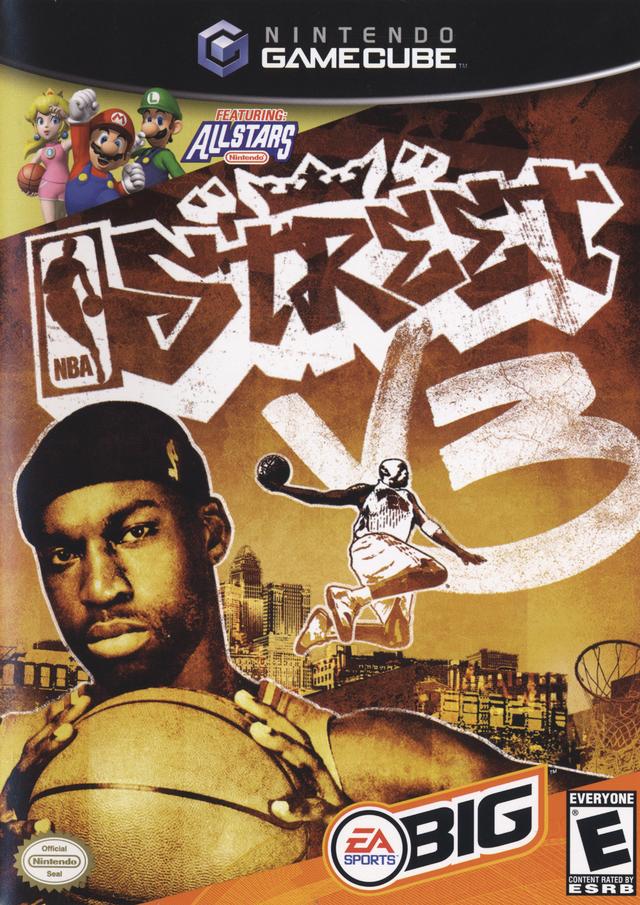
Street V3 - Street V3 is a street basketball game that features young versions of basketball legends and teams. These young pros challenge guest stars Mario, Luigi, and Peach in a 3 on 3, from the streets to the hoop basketball game. This game plays like any modern basketball game, perhaps with it's age showing a little bit. The controls are not any better or worse than "fine", while actually playing the game is just fun. It's fun to sink 3-pointers or slam the ball through the hoop via slam-dunk. This is one hell of a multiplayer game, too. I remember a night where me and a few of my friends who know nothing about basketball played this game for hours just taunting each other as if we were in the streets, ourselves. The single player in this game is solid, though it can become repetitive after a little bit. If you're looking for a tight single-player experience, pace yourself when it comes to Street V3;       multiplayer is where this game shines.

Tuesday, April 1, 2014

Metroid Primate

The distance between my WiiU and me has put me back in the mood to go on some kind of grand adventure. I was super into Darksiders II on the WiiU and as a result of me leaving my WiiU at home, I am left to my Gamecube while I am here, at school. Now normally, this wouldn't be any issue at all since Nintendo is known for it's large adventure games with great characters and gameplay. With a longing for something bigger than I am, I decided to resume my Metroid Prime experience. Unfortunately, I found that this game was much more of what the doctor diagnosed, as opposed to what the doctor ordered.


Metroid Prime

Metroid Prime is the Metroid franchise's debut into the 3D world, much like how The Legend of Zelda: Ocarina of Time paved the first 3D path for the hero of time on the Nintendo 64. Many fans were horrified of the idea of Metroid transitioning from 2D to 3D. "What if they fucked it up?", they asked. "I hope they don't do it wrong!" they exclaimed. Well unfortunately, the fans were wise to be so concerned. Metroid Prime is simply a lazily made game with embarrassingly bad graphics, power-ups and abilities copied from other series, and a soundtrack that is only memorable because of how annoying it is.


Let's start with the environment, since it is this aspect of the game that we as the player have the misfortune of having to deal with more than anything else. This game was released in 2003. At that point, Nintendo had only been making video games for about 18 years, so I am willing to be merciful when I judge a game made with only a few years of experience under their belts, but it seems obvious that Nintendo's claims of compensating for bad graphics with better gameplay started way before the days of the Nintendo Wii, only the gameplay here too was shoddy. The graphics in this game are shockingly mediocre at best. There are times when the graphics do have some strong points, for example, the design for the space pirate enemies are admittedly somewhat realistic, but generally, the environments are bland, monochromatic wisps of negligible design that serve not as a compliment to the game, but as a reminder only of what could have been had Nintendo spent some more time considering level designs. I give it a B-

Next we have control scheme and soundtrack, appropriately written about simultaneously because they are both frustrating and poorly done. In the past, Nintendo has had success making attempts at being innovative and breaking molds - just take a look at the Nintendo 64 controller. When it comes to controls though, Metroid Prime was a collection of new ideas that should have never made it to the final product. Shooting, for example, is done unconventionally with the A button as opposed to the industrially-standardized R button. This transition took weeks for me to get used to before I finally had to reconfigure the controls manually and reassign the shoot command to the R button, like how everyone in the whole world is used to. Thank you Nintendo for trying something new, but please, don't fix what isn't broken. And speaking of broken, the soundtrack to this game! I honestly think that the speakers on my TV are broken when I play this game. To me, it seems that the soundtrack is half-missing from the disc! What comes off as some pretentious attempt to add a soundtrack that compliments the environment really only leaves a bad taste in my mouth. Some people praise the soundtrack for this game, but they're elitists who claim to have grown out of music that requires drums or guitar. Excuse me for thinking that a piano and ambient-exclusive soundtrack gets boring after playing the 60 hour game for the first 15 minutes. Perhaps a soundtrack that compliments the environment would have worked better if there was any real environment to compliment. Nintendo, if you're going to base every bit of your game off of the surroundings, then please make sure that you remember to include the surroundings in your game. C+

And finally we end this nightmare of a game with a brief discussion of how every single power-up in this game is stolen from another franchise. Understanding the way that other games execute their ideas is essential to developing your own game, but the similarities must be subtle unless they are obviously references, like how Dragon Ball Z's 7 Dragon Balls is a blatant reference to Sonic The Hedgehog's 7 Chaos Emeralds. Let's take a look at some specific examples:
Charge Shot = Mega Man
First Person Camera = James Bond 007: Golden Eye
Morph Ball = Sonic The Hedgehog
Spider Ball = Spider-Man 2
Double Jump = Dragon Buster
Ice Beam = Rayman Arena
Missiles = Galaga
Energy Tanks = Legend of Zelda
Grapple Beam = Indiana Jones
The Life-Sucking Metroids = Stand By Me (film)
Female Protagonist = Alien
Wave Beam = Wave Race 64
Arm Cannon = Planet Terror

Overall, this game was too easy, too long, and too annoying to actually play through. Admittedly, I only played through about 20-25 minutes of the game before deciding that it was not for me. Maybe I am missing something, but if you ask me, this game is simply a no-go. Happy April Fool's Day.

Saturday, March 29, 2014

Namco

I just beat Tales of Symphonia. It was amazing. It was made by Namco. BUT I am not quite ready to write a review on it yet, as it will probably take a bit of thinking to really form my final thoughts on that game, so instead, I am considering which other Namco games I have really enjoyed in the past or present. Soul Calibur 2 is among my favorite Gamecube games ever and that was made by Namco, but what about that round guy? You know, apparently gaming's most iconic character. Not Mario, not Sonic, but the yellow cheese wheel that Americans call Pac-Man!

Ever since his arcade debut in year 1980, Pac-Man has been eating fruit and taking out ghosts in almost every genre that 80s gaming would allow. He has seen Tetris spin-offs and even female spin-offs. If you wanna get your best bang for your buck when it comes to Pac-Man trivia, check out Did You Know Gaming's website for a video all about the hockey puck. You guys are here for another reason though: to find out MY thoughts on a game that I enjoy. Now that you know that today is all about Pac-Man, I bet you're beginning to wonder which game I plan to discuss. Pac-Man on the Gamecube? There's only 1 best answer.

Pac-Man World 2


Pac-Man World 2 is a sequel to Pac-Man World released in year 1999 for the Playstation. Now I admit, I didn't play the first Pac-Man World game so I can't compare it to it's sequel, but I can discuss why I think Pac-Man World 2 is a fun game totally worth the $3 price tag! Hmm, I guess I'll go Gameplay, Level Design, and Soundtrack for this one.

The gameplay of Pac-Man World 2 actually reminds me a lot of Crash Bandicoot with abilities taken from Super Mario 64 and Sonic Adventure. You control a fully 3D Pac-Man in fully linear 3D levels just trying to navigate from the beginning of the level to the end. There are 25 levels spread across 6 different worlds ranging from Forests to Volcanoes and in order to beat the game, you must utilize your jump, butt-bounce, and rev-roll ability to beat every level. It's a pretty simple game that depicts how easily gamers used to be satisfied, but it is a delight to be playing again. When it comes to what sets this game apart from other linear platformers, really, there isn't much to say. This game was, as I like to say, "standard stuff", when it came to gameplay. However, like a fine wine, this game has aged quite well. When it comes to platformers, game developers nowadays have put so much effort into making this genre that tends to be a bit on the shallow side grow. They add guns, gimmicks, and speed to try to set their game apart from platformers of the past. Going back and playing old platformers can cause just as much of a culture shock because the difference between platformers made in 1999 and platformers made in 2007 is just as great as the difference between platformers made in 2008 and platformers made in 2014. True, it may take an experienced gamer to appreciate an older title, but I think that this game is simply so much fun, that the experience necessary to tolerate its age is less vital than it would be if this game wasn't any fun at all.

Now LEVEL DESIGN is another story. Holy SHIT this game just looks amazing. Not that it is graphically extraordinary, but the colors, the art-style, the models, the ghosts, the environment is just so bright and colorful that I feel like I am going to shit balloons for an hour after playing this game! Now this is definitely a good thing in the case of "why Pac-Man World 2 is different and dare I saw better than other platformers of its kind VS. people who aren't me". When a game, especially a platformer, is only average in 1 category of it's core experience, its only hope of doing well in the streets relies in its ability to compensate enormously in its other features. Pac-Man World 2 totally nails it when it comes to level design. This game is a pleasure to look at. Every color is so bright that even Pac-Man himself has a gigantic smile on his face during the entire game! What makes this especially pleasing to hardcore gamers is that this emphasis on color is actually a clever nod to the original Pac-Man back from 1980. Every ghost in the original Pac-Man game was originally supposed to be red. As a result of a survey taken by volunteer gamers back in 1979, each ghost was given their own unique color, Red, Cyan, Orange, and Pink in the final game. The fruit in Pac-Man were also always brightly colored, as fruit is in real life. This importance of color has obviously been cherished over at Namco, as their utilization of bright greens and blues really shows through all of Pac Land, right down to the power pellets.

And to finally make up for the reused platforming concept featured in Pac-Man World, we have the soundtrack. This game's soundtrack....THIS. GAME'S. SOUNDTRACK. is actually one of my favorite soundtracks of any game I have ever played, INCLUDING Guitar Hero Rocks the 80s and Tony Hawk's Underground 2. The game features orchestral music which is actually really well-composed. It has a really triumphant yet accessible feel to it that makes you want to save the damn world while humming. The game has an extremely catchy main theme, and every individual level features background music that is some sort of variant of the main theme. But of course, no soundtrack would be for-real unless it matched up with the theme of the level. Each variant of the main theme in each level is composed with respect to the level in which the song is featured. The ice themed levels are very peaceful with a lot of bells and chimes. The forest levels emphasis a lot of percussion. The Graveyard levels feature a lot of jarring harmonies- you get the point.  And finally, the sound effects. Not much else can be said other than they are mostly the exact sound effects used back in 1980. Everything from eating pac-dots to losing a life utilizes the same sound effects that were used 23 years before this game was released, much like how Sonic's signature ring-collecting sound hasn't been changed since Sonic's debut in 1991. It's clever and familiar as it is always comforting to witness something that simply is not affected by time.

I bet all this talk of Pac-Man has put you in the mood to play! Well that urge, once more, is something that is addressed by Namco in Pac-Man World 2. Among the collectible fruits scattered across each of the game's 25 levels (each of which are about 5 minutes long) are tokens. Tokens can be collected and exchanged for classic Pac-Man titles in the Pac-Man World 2 arcade! Collecting sufficient amounts of tokens will grant you access to the original Pac-Man, Ms. Pac-Man, Pac-Attack, Pac-Mania, AND brand new 3D mazes that play the same as the original Pac-Man, but were designed especially for Pac-Man World 2. Nothing like a new spin on an old game, especially when you can play the old and new games back to back!

Pac-Man World 2 is a damn fun platformer whose bright colors and surprisingly good music will bring you back to gameplay you may have thought you'd seen the last of many years ago. I'd recommend to Crash Bandicoot, Sonic the Hedgehog, and Pac-Man fans, as well as fans of platformers that emphasize collectibles, as there are quite a lot of them in this game. If nothing else has convinced you, if you see it in the store, it will have a $3 price tag and I say that it is fun. Isn't that enough?

Wednesday, March 26, 2014

What's Good With That Game - Paper Mario Thousand Year Door

In celebration of what feels like the end of a thousand year break from this blog, I shall resume my work with a game whose story also has to do with a thousand years!

Despite having pestered my friend all summer about returning my copy of Paper Mario Thousand Year Door to me, it wasn't until just a few weeks ago did I finally get to really devote some time to sitting down and playing it. Just a reminder, What's Good With That Game is an arch of this blog where I write about a game that I have only played a small bit of (less than half) so we can witness how my initial feelings towards the game either change or remain the same as the game goes on. As of this point, I have just completed chapter 3 out of what I am guessing is 7 or 8 chapters. I have about 11 hours clocked on my file "dicks" and I am still having a blast playing it. So, as Mario does, allow me to jump into it.

Paper Mario Thousand Year Door


The Paper Mario series has been one that combines a side-scrolling open world with strong influences from RPG and platforming games. Gameplay and progression is rather Zelda-like, as you typically spend a bunch of time in several different locations, get some new items or a new ability, and use that ability, along with abilities obtained earlier in the game, to solve puzzles, hit switches, find keys, defeat bosses, and save days. The game is divided up into chapters to provide clear separations between sections of the game like a story book, and the fighting system is a really refreshing and rather hands-on turn based RPG. So with this in mind, we ask the same questions as always:

Why did I pick up this game?
What do I think of it so far?
What do I anticipate?

I got a WiiU and 3DS for Christmas (divorced parents FTW). I've been playing a lot of Sonic Lost World for both systems along with Sonic Unleashed which I have been playing with my suite mate at school. I've also been playing Donkey Kong Country Returns, Monster Hunter 3 Ultimate, Super Mario 3D World and Cave Story 3D. A lot of these games are just platformers or adventure games with little depth. Although I love each of these games so much, I did long to play something more story-driven, and since I keep my WiiU at home so my brother can still enjoy Darksiders 2 and Pikmin 3, I have not much more than my trusty Gamecube and a bunch of unopened games from the summer to play. One of those games was Paper Mario Thousand Year Door. Recommended to me by my friend SchistOnUranus, whose opinion I consider very highly, I decided to give this one a go, expecting that if anyone was going to provide me with an experience that was going to make me feel like the hero I longed to be, it would be Nintendo. I looked forward to a story-driven adventure game, and I've been beginning to think that I am getting so much more.

For me, Paper Mario Thousand Year Door had a slow start. I walked around the main town, Roguesport, for a bit, solved some puzzles, fought a dragon, typical ZeldaMarioMetroid stuff. The game essentially has 2 different ideas fueling the entire experience: oldschool Zelda Dungeons and Final Fantasy turn-based RPG fighting. Now I was aware of this going into the game, but I had trouble determining which area was going to offer me the most consistent level of fun. I expected the open-world and exploring to be the part that I enjoyed more, as opposed to the fighting which I thought would be shallow. Because of this, I began my Paper Mario experience running around a pretty large world that admittedly had little to explore while skipping over a majority of the avoidable fighting, but I was wrong to do so. It wasn't until I started to fight more and increase the levels of Mario and his pals did I realize that fighting was much less of a hassle, and was a lot more fun than I had originally thought. You are pretty weak in the beginning of the game, and there isn't much you can do about it, but the more you fight, the better you get, and when each fight changes from a world that stresses you the fuck out to a world that involves you stomping on Dragon's heads and pounding Goombas with hammers, it really starts to establish itself as the better half of the game. The chapter I just completed, Chapter 3, had a lot of emphasis on fighting and even though I consider turn-based games to be slow, I was thoroughly entertained during all of chapter 3, so much so that I do dare say I am excited for chapter 4.

I am usually pretty skeptical about games I play nowadays. I am just so afraid of spending my time playing a game I don't enjoy that I look for reasons to put games down instead of looking for reasons to continue playing them. However, the more I think about Paper Mario Thousand Year Door, the more trouble I have deciding why I would stop playing it. It is a great difficulty level, does not require a walkthrough, minimizes grinding of both fighting EXP and coins, and has a good story that is simple, yet effective. My only complaint so far is that sometimes there is WAY too much fucking talking. I find my self spamming the A button during most of the text as of recently. Sometimes, I just want to play, and when I do, just shut your fucking mouth.

In the end, I look for games that I will pause because I want to take a break, not because I am stuck, lost, or lacking the necessary skills. Honestly, eventually I do plan to get back to that list of my top ten favorite Gamecube games and when I do, this may be a contender. Paper Mario Thousand Year Door is a perfect difficulty and is just fun to play, and honestly, games that can be described in such a way can be tough to find today, so if you're looking for one, both SchistOnUranus and I are recommending this guy to y'all.

Note: From what I have seen of the game, South Park Stick of Truth is a Paper Mario game in disguise. If you like one, you'll probably like the other.

Sunday, December 22, 2013

This Bitch Contains Spoilers

I've been playing a whole bunch of Metroid Prime recently. I feel like I am somewhat near the end of the game, but I have hit what seems to be a little bit of a wall- and by "wall", I mean "huge fucking monster with fucking all this shit that he keeps using to fucking kill me over and over." I am currently up to the Omega Pirate fight in Metroid Prime, and it really is such a damn good boss fight. It got me thinking about other memorable bosses I've had to slay in the past 19 years, and I just felt like writing about some of my favorite, or least favorite ones.

Omega Pirate - Metroid Prime
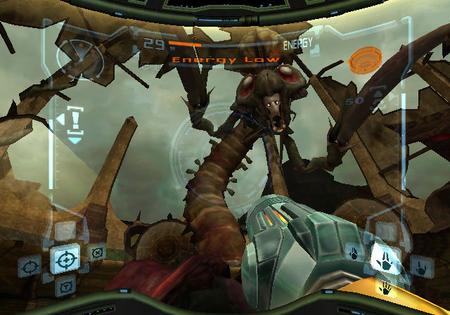
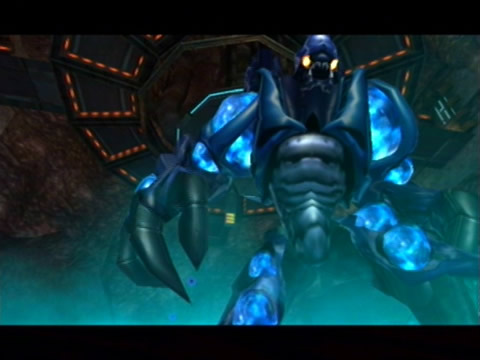
Jesus Christ this boss had been wrecking my shit. Basically what happens is Samus enters a chamber with a giant fucking monster sealed inside. The monster appears to be locked inside a pod, but evidently, the real breakthrough in locking technology didn't come until well after these science experiments were stored away. So, of course, the monster sees Samus and breaks out of her prison with the purpose of becoming Samus' best friend and falling in love with her and making sure no harm ever befalls her for the rest of her days. So Ms. Omega Pirate starts fucking attacking you. She has 4 weak spots encased in ice and they all must be struck in order to weaken her. So you shoot some missiles at her icy limbs while dodging the shock waves emitted from her giant ground-pounding fists of doom BUT these attacks must be timed properly or else they will be absorbed by Omega Pirate. Once her limbs are annihilated, she will send in some of her subordinate bitches to distract you from attacking her while she becomes invisible and attempts to regain her health. If you are able to destroy her minions quickly, you will have enough time to strap on your X-ray visor to see the invisible asshole and shoot her in the chest. You gotta do this like, 4 times to beat her, and it's HARD. FUCK.

Deathborn - F-Zero GX

This was literally a race from hell. Captain Falcon basically gets transported to hell in order to race a guy named Deathborn. If Deathborn wins, he will be able to seize the power of light and darkness for himself and destroy the universe. Because that's how it works. So this track is long, there are so many sharp turns, there are bombs all over the track AND even if you manage to survive all of the crazy shit happening on the track, you still have to navigate that shit faster than Deathborn does. I could barely beat this guy on Easy mode; I can't imagine what it is like on Hard. This is one great game, but sometimes it is so unbelievably difficult, and this boss fight doesn't make it any easier.

Andross - Starfox Adventures
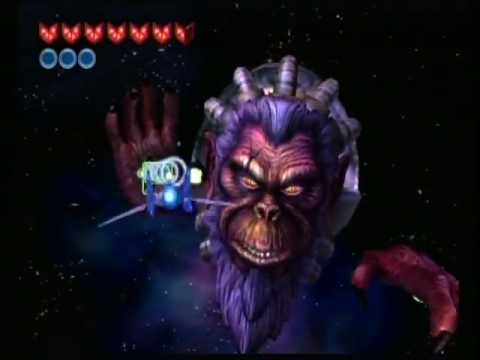
So basically after spending an ENTIRE game on foot, out of your arwing, and with a dinosaur at your side, you fight the final boss of this game, Andross, the SAME EXACT way you fight bosses in Starfox 64. Andross claims to be the one responsible for all of the misfortune that has befallen Dinosaur Planet, but he is NEVER mentioned before this fight, not even a little tiny bit. As soon as he appeared on my TV screen, I just screamed "What the hell!". Andross had NOTHING to do with Starfox Adventures, yet at the end of the game, there he is, waiting yet again to be slayed by Starfox and Falco. OH YEAH. Also Falco makes his first appearance in this game during the last boss fight. Apparently before the events of the game unfolded, he bailed to start his own star-team, but I guess it didn't work out(?)  This boss was in such contrast to the rest of the game that it is literally laughable. It's still fun in my opinion, but it is so sloppily done.

Giga Bowser - Super Smash Bros. Melee

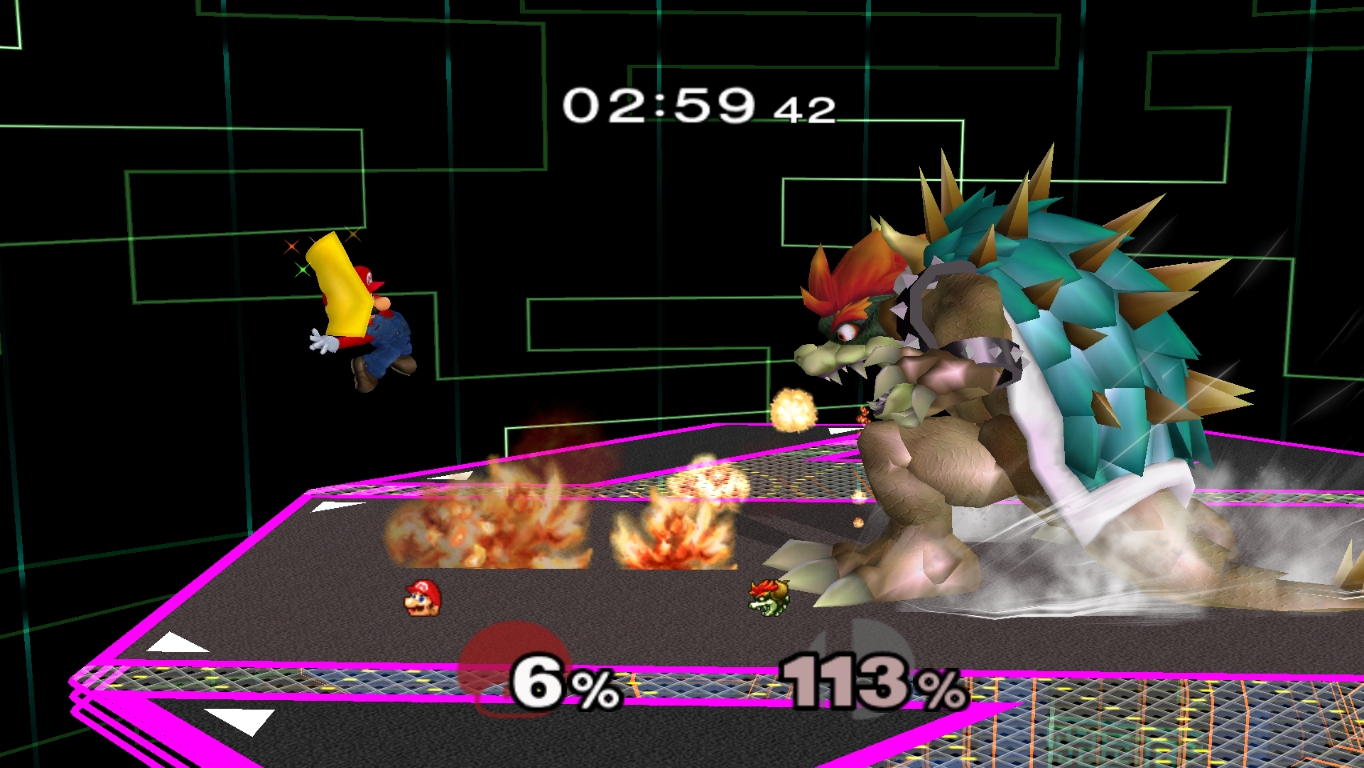
Mwahahahahaha Giga Bowser! Event Match 51, everybody. I remember beating this colossal-sized King Koopa in elementary school. I remember my friend telling me that I had to use Jigglypuff's Rest attack in order to win. It wasn't until many years later did I go on to beat Giga Bowser and friends with Marth, Link, and Luigi, in addition to Jigglypuff, but before those days were simpler times and simpler melees. Now, I play this boss over and over just for fun but I used to really struggle with it. This boss isn't really too hard if you're good at Smash Bros., but it sure is fun.

Ganondorf  - Legend of Zelda Twilight Princess
THIS boss. This may be my favorite boss fight in any video game I've played. Finally, after all these 20 years of Zelda do we get a real 1 on 1 sword fight with Ganondorf himself. I wish playing against this boss for fun was more viable. Tedious smaller boss fights between this final fight and the last time you are able to save the game puts about 20 minutes of playing other shit before I get to fight Ganondorf, but if that wasn't the case, I would play this fight everyday, and I am probably not kidding. You get a small arena in the middle of Hyrule field where you and Ganondorf each draw your swords and take turns swinging away and blocking all of the swift strikes dealt. No gimmicks, no waiting for him to expose his weak spot or become dizzy from doing his spinning-attacking or anything, just a straight-up duel. Of course, there is always the option to distract him by casting your fishing rod! The first item of the game comes back with an easter egg so lethal that you can almost save the world with it alone! But if that is not your style, you just lure him in and attempt to knock him about the arena with your master sword, ending the fight by...! Well you'll just have to play the game to find out.

Thursday, December 12, 2013

Sequels

I've been listening to a band called Autopilot Off recently. They fucking rock and they entered my life the same way some of my all time favorite bands did in the past. Goldfinger, System of a Down, Less Than Jake, Bodyjar, Cauterize, Crush 40, and Autopilot Off were all introduced to me via the video game. When ever I think about certain bands, such as the bands I listed above, sometimes I get brought back to the game that exposed me to that music. In which game did I really learn about Autopilot Off? SSX 3.

So I turned on SSX 3 again for the first time since the middle of the summer today because I wanted to listen to some Autopilot Off and maybe because it just snowed the other day and it was appropriate. After a whole bunch of racing and freestyle runs, I started thinking something rather treasonous:

SSX Tricky or SSX 3?

I think SSX 3 is a better game than SSX Tricky. There. I won't be clever and wait until the end of the whole fucking post before I come out and say it. I love both SSX Tricky and SSX 3, but I prefer SSX 3 over the former. The main question that I ask myself is the following: Why is it that SSX Tricky is the game that I find more people talking about when I feel that SSX 3 is a better game? Unfortunately, I don't have the energy to actually determine the answer to that question, but what I can do is compare the two games so you guys can decide for yourselves. SSX Tricky or SSX 3?

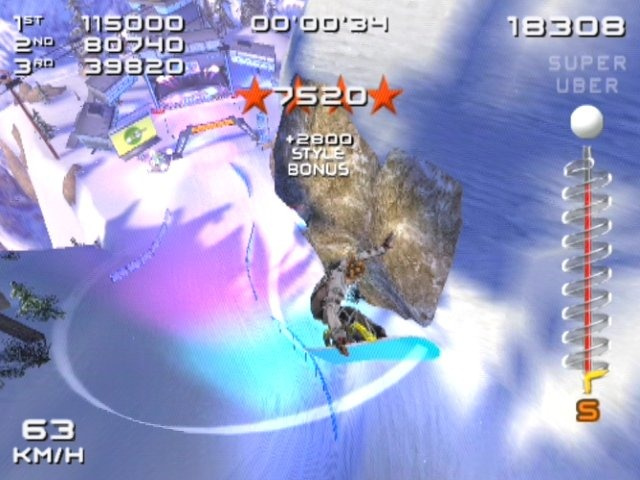
So here we go. The SSX series is a series of snowboarding racing games made by EA Big. There are several installments in the series, including 3 for the Nintendo Gamecube and at least 1 for the Wii (I don't claim to be an expert on Wii....yet). Based on the conversations I have with my friends both at home and at college (so you can tell I am getting a really wide range of people here), it would seem that SSX Tricky is the more popular game. For that reason, it must be the better game! SSX Tricky is an AMAZING game that kept my younger self entertained for weeks and weeks and weeks at a time, but I am not certain if it matches up with SSX 3, personally. I suppose I'll start off by discussing the features both games have in common.

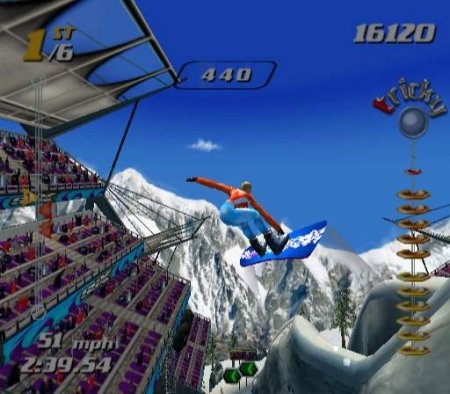
SSX Tricky and SSX 3 both offer 2 main types of single and multiplayer player modes: Race and Showoff/Freestyle (Showoff  in Tricky and Freestyle in 3. They're the same thing.) Race mode has you blasting down huge snowy mountains as fast as you can in an attempt to get from the beginning of the course to the end of the course in less time than it takes your opponent. That's how a race works. Showoff/Freestyle is a mode where you basically have the entire course as your own personal skatepark. You start at the top of whatever course you want, and try to score as many points as you can by doing all sorts of different crazy tricks before you cross the finish line. Each game has several different courses to board on. Each game has an upgrading system where you will get to choose which of your rider's stats you wish to increase, and the abundance of these opportunities increases depending on how brutally you kick your opponent's ass during the race. There are many different boards with all different stats for you to unlock AND there are different clothing options for each character that are purely cosmetic.

So both games have the same basic formula. And I'm not kidding, like, they are pretty much the same idea. Same equation and formula. No risk taken from Tricky to 3. This presents us with a unique opportunity where we can just literally compare the two games track by track, move by move. It's not like comparing Super Smash Bros. Melee's Adventure Mode to Brawl's Subspace Emissary, where they are completely different but are forced to be compared. SSX Tricky and SSX 3 have so much in common that it is incredibly easy and natural feeling to compare the two. It is a case like Minute Maid lemonade vs. Country Time lemonade where we can just say "This is better because I like it more." So. Obviously the games aren't EXACTLY the same, they just function the same. They look different, feel different, and play differently despite their concepts being akin. So we only have a couple of different things to compare, and a side by side comparison would be most efficient.

Let's start with the characters. Pretty much the same characters give or take a few newbies added to SSX 3 from SSX Tricky. Personally, I feel that the updated graphics that come with a game being newer does wonders for the SSX 3 character roster. It looks better since it is the same art style, and because it is newer. Visual appeal goes to SSX 3. Also, IM SORRY, but as much as everyone loved the announcer (Rozell?) in Tricky, SSX 3 has a real soundtrack complete with the auto-synching feature. Which means like, if in these rock songs, normally, there is a quiet section, then that quiet section is going to be played while you're in a dark cave. Then once you come shooting out of that cave, the chorus of that song is going to slam through the TV speakers, and the best part of the song is going to be pumping through while you're high in the air about to land and shit all over your opponents. Like how music is in a cheesy summer-movie made in the 90s? That's what SSX 3 does. Sound goes to SSX 3 as well.

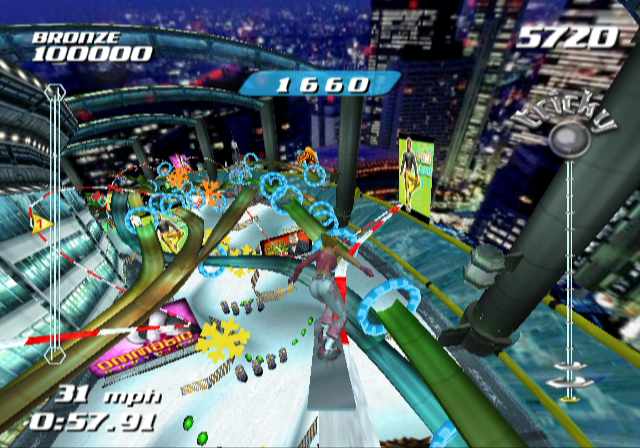
Courses. Perhaps the tracks in SSX Tricky are more memorable. Maybe this is the result of nostalgia or because I've spent more hours total playing Tricky when compared to 3. I do feel that there was less emphasis on the course designs in 3. They don't feel lazy, in fact, they really are awesome. But, like, for example, the name of each course in SSX Tricky is blown thrown the TV speakers every time you select one. In SSX 3, they are not. And because in SSX 3, you can technically access a majority of the courses from an open-world-ish hub, you may play many courses without even knowing their names. Perhaps what I am trying to avoid saying is that even though the courses in SSX 3 are really damn fun, they do all kind of look the same - just a bunch of snow and a bunch of ramps. Fun, but I mean, Tricky has Tokyo Megaplex on its side....courses go to Tricky.

Finally, with a 1 to 1 score, we have how the game feels. Tricky does an amazing job of incorporating the element of doing tricks with the controls that can feel button-mashy but work, into a game that is not necessarily always about doing tricks. Maybe you'll want to tone the showoff inside of you down while you're ripping through tougher courses in SSX Tricky. This is because in Tricky, accidentally performing tricks you never wanted to do happens often and can REALLY fuck you up. It is very easy to accidentally stop performing your front flips (for example) while you're upside down. So like, you're blasting through a course, and a surprise ramp pops up from out of no where. Because you didn't see the ramp until it was too late, you're still holding up on the control stick, because holding up on the control stick makes you accelerate when you're on the ground. BUT in the air, holding up makes you flip, kinda. So before you know it, you're upside down, you're in the air, and you're about to eat shit and once you do, it's over. Time to press Restart. SSX 3 completely fixed this problem. In SSX 3, you automatically complete your flips every time they are executed. It's like the bottom of your board is magnetized to the snow. It makes doing double front flips on flat ground possible, but who cares how unrealistic that is? If you're going to spam tricks all day during the race, you're going to lose anyway. The point is that SSX 3 has solved the one problem SSX Tricky had with its trick system- you pretty much automatically land them every time. You still have to avoid hitting trees and stuff, but there is no bullshit when doing the tricks; each one can be performed with confidence. With the installation of SSX 3, the SSX series has finally worked out every kink in the system that links doing tricks to going fast, and for that, SSX 3 takes the best-feeling trophy.

Looks like SSX 3 wins 2 to 1. Of course, this is all just my opinion. I cannot discredit the volunteer opinions of my friends - SSX Tricky MUST be an awesome game since so many people always want to play it when they see that it is in my library. I couldn't resist getting the sequel because I was curious, but perhaps some of you may join my side one day. SSX 3 I do believe is only 5 or so dollars on Amazon. Enjoy, and don't forget that whether it is in a game or in real life, yellow snow is piss. Don't eat it.