Yu-Gi-Oh! The Eternal Duelist Soul - GBA
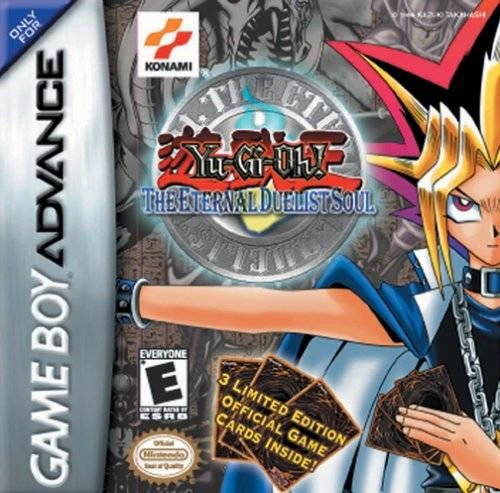 The popular Japanese manga-turned-game-turned-international sensation saw many different video game interpretations, some re-imagining Yu-Gi-Oh! as a turn-based RPG, to an open-world Pokemon-ish game, while other publications stuck to the rules and characters that made the franchise popular in the first place, and few accomplished the later more successfully than Yu-Gi-Oh! The Eternal Duelist Soul.
Unlike many other entries to its video game career, Yu-Gi-Oh! The Eternal Duelist Soul sticks to the original rules of the traditional card-based game; it's these same rules with which EDS expects players to be preemptively familiar in order to play, as there exist no tutorials in EDS, making it somewhat impenetrable to gamers unfamiliar with Yu-Gi-Oh! That being said, the game initially offers opponents that are fairly easy to defeat, and as a result it may not be too difficult for determined newbies to quickly get the hang of what winds up becoming a fairly challenging game. The experience of Yu-Gi-Oh! video games will always inevitably be different for those who are long-time fans and those who have never played before, but since EDS doesn't allow you to make moves or play cards that don't abide by the rules of the game, it doesn't really take too long for novices to become familiar with what does and doesn't work.
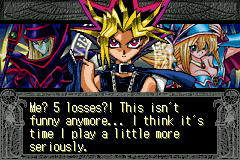
 Players begin the only single-player game mode by selecting from 1 of 3 decks to get you started. There is no way of knowing which decks contain which cards, but all 3 are sufficient for getting you through your first few duels once you become familiar with the rules of the game. Initially, you have the option of dueling against 5 faces familiar to even the most casual Yu-Gi-Oh! fan, and additional opponents are unlocked after having defeated each character in each tier a specific number of times. Each collection of characters unlocked serves not only as fun guides through the first 2 seasons of the Yu-Gi-Oh! anime, but becomes increasingly difficult and fun to duel against. After you win any duel against any opponent, you are brought to a screen where you get to choose 1 booster-pack to open. Each booster pack holds cards that are unlocked and available to you after selecting to claim them, though once again the contents of each pack is random until it is opened. Constant acquisition of additional cards that you are encouraged to add to your deck helps to keep things from becoming stale. Abstaining from making changes to your deck may result in frequent loses as the skill of your newest opponents becomes more considerable, so having a consistent influx of new cards is an efficient way to make progress and pacing fluid.
The goal of the game is to advance to and then win the Yu-Gi-Oh! World Championship. Each duel either won or lost advances the calendar by a single day, and there are a great number of days to get through before the Yu-Gi-Oh! World Championship arrives. Players will spend most of these calendar days dueling against new opponents to unlock more cards and characters. Unfortunately, there is an extremely large number of days between unlocking the final opponent and unlocking the World Championship, and the game slows to a grinding hault during this second half, which abruptly withholds new content.

Though there are now countless Yu-Gi-Oh! video games out there, I find myself drawn to replay Eternal Duelist Soul every couple of years. The best part about Eternal Duelist Soul is that despite it featuring out-dated cards and strategies, the cards it does feature are the original cards, and your opponents are the original characters from the original cast. Eternal Duelist Soul is to Yu-Gi-Oh! as Red and Blue are to Pokemon. The value in EDS lays in its ability to encourage casual fans to sharpen their knowledge of the basics of the real-life game. Attempting to dive head-first into the world of Yu-Gi-Oh! nowadays can be a tall order, and introducing a new duelist to the latest strategies and combinations can be daunting, but playing these old video games that are more-or-less Yu-Gi-Oh! simulators can be extremely helpful for one trying to begin to play the real-life game. Moreover, EDS and other old Yu-Gi-Oh! games are fun for veteran fans who may have missed out on the opportunity to use old cards and strategies that may have seemed fun at the time but are now out-dated. My Exodia deck is unmatched in this period of Yu-Gi-Oh's history.
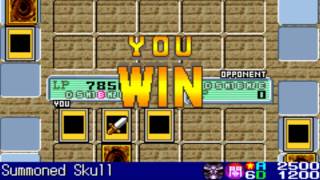 Retrospectively, Yu-Gi-Oh! The Eternal Duelist Soul doesn't offer anything that can't be found in any other Yu-Gi-Oh! game. There are fewer cards, fewer opponents, and fewer strategies to be seen in this classic title, but Eternal Duelist Soul may be valuable to players who wish to get a grasp of what Yu-Gi-Oh! is without throwing themselves into the deep end of a pool filled with unfamiliar monsters and demons (literally). EDS is also still fun for old-time Yu-Gi-Oh! fans who yearn for simpler times of a simpler game. With the exception of some outdated banned-lists and rulings, EDS offers a genuine Yu-Gi-Oh! experience all wrapped up into a handheld video game with an impressive amount of content and replay value limited only by your ability to conceive of new and fun decks and strategies.
.jpg)