Nintendo Consoles

Nintendo Consoles
Showing posts with label Metroid. Show all posts

Monday, December 21, 2015

Metroid Zero Mission

Metroid Zero Mission -
Gameboy Advance 

In the year 2004, two years after the series' debut on the Gameboy Advance with Metroid Fusion, we received a game that would not only be the second Metroid title on the Gameboy Advance, but many gamer's second chance to experience the Metroid series in its original capacity. While Metroid Zero Mission is technically a remake of the original Metroid released on the NES in 1986, it certainly has no problem justifying its own existence. Updated graphics along with the original Metroid in-full now being literally in the palms of your hands are nice touches, but careful consideration must be made when reviewing this retouched game; does the original Metroid still hold up even with meticulous updating, or is this one classic better left back in the 80's?

The story, as is the case with many Metroid games, is easy to understand. Our protagonist, Samus, is sent to Planet Zebes in order to annihilate the mechanism being used by opposing space pirates to build super weapons. With the exception of a few cutscenes added in order to update the feel of the original (at that point) 18 year old game, Metroid Zero Mission pretty much leaves you to explore on your own. Those who have never played a Metroid game before should have no problem entering the series via Zero Mission, as multiple difficulty levels are available to select right from the start, and even on Normal difficulty, the game isn't too challenging.
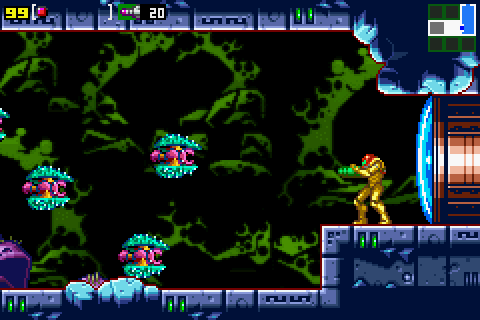
The difficulty usually associated with the Metroid series stems from the player lacking the intuition necessary in order to figure out where in each of the game's 7 (later, 8) worlds they must explore next. Navigating each room in each environment is simple enough, and the map, upgrades, and new abilities come with the exploration, along with the opportunity to uncover secret passages that more often than not will lead the way to the next area or even to supplementary power-ups such as an increase in missile-storage capacity, or health buffs. Updated graphics borrowing assets and art design from Metroid Fusion are extremely successful in bringing life to the once aging world of Planet Zebes. Hardware limitations of the Gameboy Advance seemed to be no hindrance at all while designing Metroid Zero Mission; from start to finish, Planet Zebes is an absolute pleasure to explore.

Often if a game is too easy, it can become boring. Then again, if a game is too challenging, it can become discouraging. Despite Metroid Zero Mission being a little bit on the easy, and while I'm at it, short side, it does not lack any bit of the magic that gamers have come to expect from other Metroid games. Initially, the map sizes of many of Zero Mission's environments, such as Norfair or Ridley, can feel intimidatingly ambitious. While "intimidating" can often mean "discouraging", as it does in many other games, Zero Mission finds a way around this through building up the confidence of the player by building up the strength of Samus. Small power-ups, such as the Charge Shot, Missiles, Super Missiles, and Morph Ball just to name a few, are awarded frequently, and the types of power-ups obtained are never too similar to the power-up most recently acquired. Missiles and Super Missiles are acquired at opposite ends of the game, as are Morph Ball and Power Bomb, as well as many other similar upgrades. This rapid change in arsenal often supports rapid changes in scenery; if you've just acquired a new weapon, you can expect a new type of area, thus a new type of gameplay.
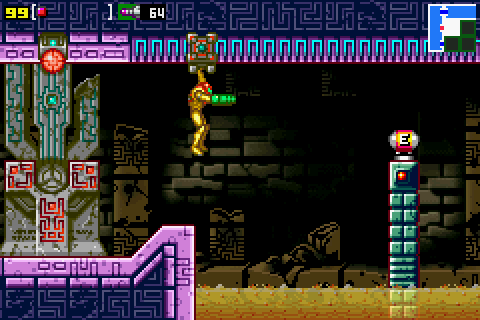
Unlike most modern Metroid games, Metroid Zero Mission only features 3 boss fights, which is 1 more than the original featured. While Zero Mission does involve a great deal of combat, from blasting small nuisances of enemies to bringing down both Kraid and Ridley, the environments prove themselves to be much more threatening than any monster, especially in the later 20% of the game. Often, the way forward will be shown on the map, but left purposely unclear in the world. Using every weapon to try to blast through every wall in the hopes of revealing a hidden path is a habit that all players of Zero Mission will get into, and even still, will often finish the game far from 100% completion.

Though an average playtime of Zero Mission will probably only last around 3-4 hours, there is plenty of content to be enjoyed after the initial play-through is completed. Finishing the game once will not only unlock Hard mode, but will unlock the original Metroid game which can be played by selecting it in the Options menu. Inputting a certain sequence of buttons on the Options menu of a game file after having completed Normal mode will also unlock Time Attack mode, which will time how quickly you can complete 1 play-through on Normal difficulty.
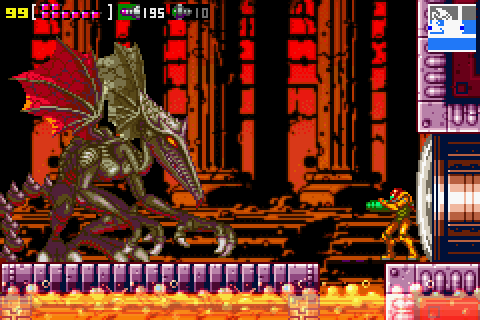
Metroid Zero Mission is short, being only a little bit longer than the original because of an extra chapter exclusive to this version, and it can be easy if played on Normal or Easy difficulty, especially if this isn't your first Metroid game. Despite this, Metroid Zero Mission is excellent. Everything from the graphics to the tone to the pacing is absolutely wonderful, and the life exuding from Planet Zebes' environments serves as a praise-worthy example of how hardware limitations can be over-come through clever art and carefully considered level-design. Whether you originally played Metroid back in 1986, or have never considered playing Metroid before, Metroid Zero Mission is not only a perfect example of what this series has to offer, but a perfect example of how fun timeless game design can be.

Tuesday, September 30, 2014

Back To Dream Land!

One of the first things I did when I got back to college was hit up the local Gamestop to see what's good. They treated me really well there last semester and low-traffic shopping malls are some of my favorite places to score inexpensive games. Among the games in the store was a Wii game I had heard about recently but knew very little about. Used some saved up store credit to grab myself a copy of the late Nintendo Wii title, Kirby's Return To Dream Land. 

Kirby's Return To Dream Land - 
Nintendo Wii 

Intro + Summary
In recent years, Kirby games have been reviewed consistently pretty well, but I never hear about many people playing them. Mostly, I hear about how the games are too short, too easy, or both, making the latest installments in the Kirby series simply not worth the $40 that could be spent buying other popular titles. This is why it took a lot of faith for me to invest in a Kirby game that cost $45 "used" after all these years. Still, I did it and I regret nothing. 
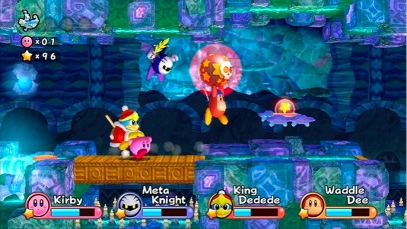
       Kirby's Return To Dream Land is a side-scrolling platformer that keeps the gay puff-ball's signature ability to inhale and copy his enemies at the forefront of the game-play experience. This time around, there are no yarn-related gimmicks or racing antics. It is just classic Kirby doing the thing he and we all love the most. This time, the antagonist is a mystery until the last chapter, and it becomes evident that the evil bad-guy is neither the classic Meta Knight nor King Dedede, because they are actually playable characters! Kirby's Return To Dream Land features 4 player co-op, much like how a number of modern Super Mario games do, making this title ideal for a either a group of friends looking to kick back and enjoy something silly and fun, as well as the perfect title for someone looking to play a fun single player game, which is how I played it.
      Does anyone remember Kirby's Nightmare In Dream Land? It's a GBA game that I remember being played by a lot of kids who lived through my generation of gaming. Nightmare In Dreamland was an incredible, memorable, and fun Gameboy Advanced game featuring the very same Pac-Man impersonator starring in today's review! Why bring it up? Because unlike the easy, short, and mildly boring Kirby games of recent times, Kirby's Return To Dream Land feels more like the fabulous Nightmare In Dream Land than any other comparable game in the series. In fact, it feels like a direct sequel - a game that takes what we all loved about Nightmare, and added to it, enhanced it, and further illuminated the bright world that was the Nightmare from which we never wanted to awaken. 

Good Things
Kirby's Return To Dream Land (at the time it was released) was one of the few times we saw the  Kirby formula in its purest form. Kirby's Squeak Squad for the Nintendo DS was received kind of well, Kirby's Epic Yarn although critically acclaimed was not the Kirby we all knew and loved, and the same could even be said about Kirby Air Ride for the Nintendo Gamecube, back in 2003. Kirby's Return is an awesome game because it succeeds in doing the things it tries to do. 
       For those who don't know, Kirby's only inherent ability is the ability to inhale enemies in each level. Kirby is usually able to copy the powers of his inhaled victims, sometimes resulting in Kirby wielding a sword, being able to breathe fire, or even turning into a laser-shooting UFO, all depending on the ability of the inhaled enemy. These copied abilities can be used to vanquish other enemies and reach the end of the level and/or unlock secret paths leading to collectibles. The main attraction to the classic Kirby games is the excitement that comes with using different powers in different levels. The objective of the game is to reach the end of each level, but the fun of the game comes from using different powers to do so. With this in mind, it becomes obvious that all any Kirby game would need to do in order to satisfy players is provide an abundance of fun levels in which the player can experiment with fun abilities. This, Kirby's Return To Dream Land does perfectly. I said PERFECTLY. With 7 worlds, 5 levels per world, 1 boss level per world, and countless collectibles whose collecting of allow you access to addicting mini-games, KRtDL offers non-stop variety in abilities and levels from the beginning to end, something recent Kirby games have been lacking. 
       To provide further contrast between Kirby's Return and more recent Kirby titles, I'd like to point out that Return has a very Nintendo-typical difficulty curve. For those who are unfamiliar, classic Nintendo games usually have a way of opening at an almost irresponsibly easy level, and then getting exponentially harder as the game progresses. I died in this Kirby game. I was concerned about my life-count in this Kirby game BUT, I never got frustrated at the Kirby game. Rather, I got frustrated at myself, because I got cocky once I noticed the game was easy and as soon as I got cocky, the game got hard. This game has the ideal difficulty level in my opinion. The later levels were quite difficult, but never made me want to rip my gorgeous hair out. The opening levels were difficult enough to suggest that I couldn't play the game with a blindfold on, while easy enough for me to learn naturally as I played. 
     Finally, a full arrangement of colors and appropriate art-style made this game a pleasure to look at, while its soundtrack literally had me going to Youtube and searching for the game's music even while the game was off, "Peaceful Place" being among my favorite tracks.


Short Comings
I find myself squinting and starring at the title of this section and saying "hmm...". Ehh I suppose you could say that this game isn't really much more than what it is. This is a platforming game starring Kirby and his friends using abilities to get from one end of the level to the other. The story is negligible and there isn't any depth to the game, nor is there anything that makes you care about Kirby other than how cute he is. Not that anyone was asking for an emotionally moving Kirby game! - I am just saying that this is not any game from which you'll walk away as a different person than who you were before you played it; it's just fun on a basic level. 
The game can be a tad-bit repetitive towards the end, as it is very possible to become fluent in the ways of every ability at around the 6 hour mark of this 8 hour game. However, that hardly makes the game any easier, plus the number of collectibles will keep any completionist playing for long after they complete the main story. I completed the main story and only achieved a 63% completion rating. This being said, the game is fun enough to justify an 8 hour story mode with ease. If this game was 20 hours, while it got repetitive after 6, we'd have a very different game here. 
     The final short-coming is the following: once the main story is completed, the only reason to continue playing is to obtain every collectible. Once every collectible is obtained, you will be able to unlock every mini-game, and that's it. The only incentive to extending your playtime beyond 10 hours is to unlock mini-games that are fun, but may not be worth the hours of grinding. I wouldn't know- I didn't unlock them all.

To Whom Would I Recommend This Game?
Nintendo fans, ANYONE who liked Kirby's Nightmare In Dream Land, anyone looking to play some fun local multiplayer, anyone who is looking for an excuse to dust off their Wii (or Wii U), anyone who wants to see Kirby on a console as opposed to a handheld, anyone in the mood to play something short and sweet

Tuesday, April 1, 2014

Metroid Primate

The distance between my WiiU and me has put me back in the mood to go on some kind of grand adventure. I was super into Darksiders II on the WiiU and as a result of me leaving my WiiU at home, I am left to my Gamecube while I am here, at school. Now normally, this wouldn't be any issue at all since Nintendo is known for it's large adventure games with great characters and gameplay. With a longing for something bigger than I am, I decided to resume my Metroid Prime experience. Unfortunately, I found that this game was much more of what the doctor diagnosed, as opposed to what the doctor ordered.


Metroid Prime

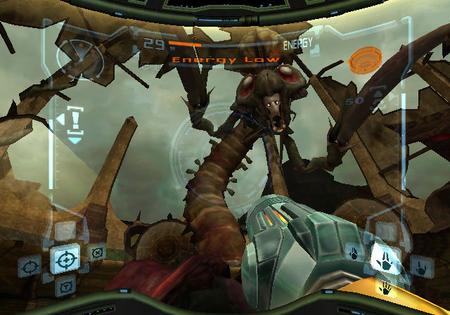
Metroid Prime is the Metroid franchise's debut into the 3D world, much like how The Legend of Zelda: Ocarina of Time paved the first 3D path for the hero of time on the Nintendo 64. Many fans were horrified of the idea of Metroid transitioning from 2D to 3D. "What if they fucked it up?", they asked. "I hope they don't do it wrong!" they exclaimed. Well unfortunately, the fans were wise to be so concerned. Metroid Prime is simply a lazily made game with embarrassingly bad graphics, power-ups and abilities copied from other series, and a soundtrack that is only memorable because of how annoying it is.


Let's start with the environment, since it is this aspect of the game that we as the player have the misfortune of having to deal with more than anything else. This game was released in 2003. At that point, Nintendo had only been making video games for about 18 years, so I am willing to be merciful when I judge a game made with only a few years of experience under their belts, but it seems obvious that Nintendo's claims of compensating for bad graphics with better gameplay started way before the days of the Nintendo Wii, only the gameplay here too was shoddy. The graphics in this game are shockingly mediocre at best. There are times when the graphics do have some strong points, for example, the design for the space pirate enemies are admittedly somewhat realistic, but generally, the environments are bland, monochromatic wisps of negligible design that serve not as a compliment to the game, but as a reminder only of what could have been had Nintendo spent some more time considering level designs. I give it a B-

Next we have control scheme and soundtrack, appropriately written about simultaneously because they are both frustrating and poorly done. In the past, Nintendo has had success making attempts at being innovative and breaking molds - just take a look at the Nintendo 64 controller. When it comes to controls though, Metroid Prime was a collection of new ideas that should have never made it to the final product. Shooting, for example, is done unconventionally with the A button as opposed to the industrially-standardized R button. This transition took weeks for me to get used to before I finally had to reconfigure the controls manually and reassign the shoot command to the R button, like how everyone in the whole world is used to. Thank you Nintendo for trying something new, but please, don't fix what isn't broken. And speaking of broken, the soundtrack to this game! I honestly think that the speakers on my TV are broken when I play this game. To me, it seems that the soundtrack is half-missing from the disc! What comes off as some pretentious attempt to add a soundtrack that compliments the environment really only leaves a bad taste in my mouth. Some people praise the soundtrack for this game, but they're elitists who claim to have grown out of music that requires drums or guitar. Excuse me for thinking that a piano and ambient-exclusive soundtrack gets boring after playing the 60 hour game for the first 15 minutes. Perhaps a soundtrack that compliments the environment would have worked better if there was any real environment to compliment. Nintendo, if you're going to base every bit of your game off of the surroundings, then please make sure that you remember to include the surroundings in your game. C+

And finally we end this nightmare of a game with a brief discussion of how every single power-up in this game is stolen from another franchise. Understanding the way that other games execute their ideas is essential to developing your own game, but the similarities must be subtle unless they are obviously references, like how Dragon Ball Z's 7 Dragon Balls is a blatant reference to Sonic The Hedgehog's 7 Chaos Emeralds. Let's take a look at some specific examples:
Charge Shot = Mega Man
First Person Camera = James Bond 007: Golden Eye
Morph Ball = Sonic The Hedgehog
Spider Ball = Spider-Man 2
Double Jump = Dragon Buster
Ice Beam = Rayman Arena
Missiles = Galaga
Energy Tanks = Legend of Zelda
Grapple Beam = Indiana Jones
The Life-Sucking Metroids = Stand By Me (film)
Female Protagonist = Alien
Wave Beam = Wave Race 64
Arm Cannon = Planet Terror

Overall, this game was too easy, too long, and too annoying to actually play through. Admittedly, I only played through about 20-25 minutes of the game before deciding that it was not for me. Maybe I am missing something, but if you ask me, this game is simply a no-go. Happy April Fool's Day.

Wednesday, March 26, 2014

What's Good With That Game - Paper Mario Thousand Year Door

In celebration of what feels like the end of a thousand year break from this blog, I shall resume my work with a game whose story also has to do with a thousand years!

Despite having pestered my friend all summer about returning my copy of Paper Mario Thousand Year Door to me, it wasn't until just a few weeks ago did I finally get to really devote some time to sitting down and playing it. Just a reminder, What's Good With That Game is an arch of this blog where I write about a game that I have only played a small bit of (less than half) so we can witness how my initial feelings towards the game either change or remain the same as the game goes on. As of this point, I have just completed chapter 3 out of what I am guessing is 7 or 8 chapters. I have about 11 hours clocked on my file "dicks" and I am still having a blast playing it. So, as Mario does, allow me to jump into it.

Paper Mario Thousand Year Door


The Paper Mario series has been one that combines a side-scrolling open world with strong influences from RPG and platforming games. Gameplay and progression is rather Zelda-like, as you typically spend a bunch of time in several different locations, get some new items or a new ability, and use that ability, along with abilities obtained earlier in the game, to solve puzzles, hit switches, find keys, defeat bosses, and save days. The game is divided up into chapters to provide clear separations between sections of the game like a story book, and the fighting system is a really refreshing and rather hands-on turn based RPG. So with this in mind, we ask the same questions as always:

Why did I pick up this game?
What do I think of it so far?
What do I anticipate?

I got a WiiU and 3DS for Christmas (divorced parents FTW). I've been playing a lot of Sonic Lost World for both systems along with Sonic Unleashed which I have been playing with my suite mate at school. I've also been playing Donkey Kong Country Returns, Monster Hunter 3 Ultimate, Super Mario 3D World and Cave Story 3D. A lot of these games are just platformers or adventure games with little depth. Although I love each of these games so much, I did long to play something more story-driven, and since I keep my WiiU at home so my brother can still enjoy Darksiders 2 and Pikmin 3, I have not much more than my trusty Gamecube and a bunch of unopened games from the summer to play. One of those games was Paper Mario Thousand Year Door. Recommended to me by my friend SchistOnUranus, whose opinion I consider very highly, I decided to give this one a go, expecting that if anyone was going to provide me with an experience that was going to make me feel like the hero I longed to be, it would be Nintendo. I looked forward to a story-driven adventure game, and I've been beginning to think that I am getting so much more.

For me, Paper Mario Thousand Year Door had a slow start. I walked around the main town, Roguesport, for a bit, solved some puzzles, fought a dragon, typical ZeldaMarioMetroid stuff. The game essentially has 2 different ideas fueling the entire experience: oldschool Zelda Dungeons and Final Fantasy turn-based RPG fighting. Now I was aware of this going into the game, but I had trouble determining which area was going to offer me the most consistent level of fun. I expected the open-world and exploring to be the part that I enjoyed more, as opposed to the fighting which I thought would be shallow. Because of this, I began my Paper Mario experience running around a pretty large world that admittedly had little to explore while skipping over a majority of the avoidable fighting, but I was wrong to do so. It wasn't until I started to fight more and increase the levels of Mario and his pals did I realize that fighting was much less of a hassle, and was a lot more fun than I had originally thought. You are pretty weak in the beginning of the game, and there isn't much you can do about it, but the more you fight, the better you get, and when each fight changes from a world that stresses you the fuck out to a world that involves you stomping on Dragon's heads and pounding Goombas with hammers, it really starts to establish itself as the better half of the game. The chapter I just completed, Chapter 3, had a lot of emphasis on fighting and even though I consider turn-based games to be slow, I was thoroughly entertained during all of chapter 3, so much so that I do dare say I am excited for chapter 4.

I am usually pretty skeptical about games I play nowadays. I am just so afraid of spending my time playing a game I don't enjoy that I look for reasons to put games down instead of looking for reasons to continue playing them. However, the more I think about Paper Mario Thousand Year Door, the more trouble I have deciding why I would stop playing it. It is a great difficulty level, does not require a walkthrough, minimizes grinding of both fighting EXP and coins, and has a good story that is simple, yet effective. My only complaint so far is that sometimes there is WAY too much fucking talking. I find my self spamming the A button during most of the text as of recently. Sometimes, I just want to play, and when I do, just shut your fucking mouth.

In the end, I look for games that I will pause because I want to take a break, not because I am stuck, lost, or lacking the necessary skills. Honestly, eventually I do plan to get back to that list of my top ten favorite Gamecube games and when I do, this may be a contender. Paper Mario Thousand Year Door is a perfect difficulty and is just fun to play, and honestly, games that can be described in such a way can be tough to find today, so if you're looking for one, both SchistOnUranus and I are recommending this guy to y'all.

Note: From what I have seen of the game, South Park Stick of Truth is a Paper Mario game in disguise. If you like one, you'll probably like the other.

Sunday, September 15, 2013

Playground Series: This Shit Is Bananas

I've recently learned to stop apologizing. So EXCUSE my bitch ass for not posting for a bit.

P.N.03

Okay so you know how when a game comes out people are all like "wahhh imma go check IGN anf fuckong.. Gameinformersomeshit fuckin'...askn all ma frendzz an whatev see hoiw good the gmae is befo I spend moneuy err whatev" I say FUCK THAT. In order to know how good a game is, you have to play it yourself. And no game has taught me that lesson more thoroughly than P.N.03.

P.N.03 is a third-person shooter that gives off a classic arcade-like feel. You navigate through linear levels and just try to fucking kill everything in your path before they kill you. Once you reach the end of the level, you move on to the next level. The point of the game is to beat every level and once you do, you're expected to move onto the next difficulty. This game's concept is simple and during this day and age, it could appear to be outdated and stale. This game was reviewed poorly and was criticized for it's sloppy controls, small move-set, length, and gameplay. Well you know what I say? Wanna know what I think about these claims? I think FUCK. THAT. This game is AWESOME. It's so frustratingly difficult, but rewarding and even though it only takes you 2 hours to beat the story on Easy mode, it will take you a lot longer than 2 hours to earn the ultimate prize.

So we gotta talk about all the different aspects of the game that make it what it is. Like I said, P.N.03 is pretty much a level-based action game. You start in one "room", kill all of the enemies, then move onto the next room. Once you complete every room, the level ends and you are pushed to the next one. Easy right? NO. So first of all, what you need to understand in order to play this game is that even though, yes, it is a shooter, there is only 1 or 2 buttons that make you shoot. You got the A button, which unleashes the rage of your trusty Palm Shot, and different combinations of the D-pad buttons + A for your strongest attacks. Knowing when to use your 2 different shots is important but what is even more important is knowing that every other button, including, B, L, R, LL, RR, Z and Y are all different buttons that let you dodge in different ways. The point is that health and energy necessary to charge your strongest attacks is scarce and if you fuck up, the game is not going to forgive you. Every single bit of your health counts so the skill you need to master in order to beat this game is not shooting the enemies, rather it is dodging the enemies, because you better believe that if you're trying to kill these enemies, then they are trying to kill you.
 
Imagine each room is like a spacious, in-door paintball arena. There are sections of the room where you are out in the open, as well as sections where you can jump and duck behind things. Using the environment in order effectively avoid the enemy onslaught while picking off each enemy one by one is critical in order to beat, or even play this game. The incentive to avoiding every single bullet shot at you, in addition to not dying, is the fact that the game awards you a certain amount of points each time you complete a room, and then gives you a nice bonus each time you complete a level. Wow points? Like fuckin....Super Mario Bros. or some shit? Yeah points. Obviously, whenever someone hears the word "points", they think of older games. Points, and trying to achieve the greatest amount of them, is a personal goal. In Mario Bros, you aren't rewarded for getting a high score with some kinda fuckin power up or something, you were just supposed to feel good about getting more points than ya friends. P.N.03 tries to rekindle that desire to snag the most points and does it flawlessly.....not satisfied are you? Okay, you got me. P.N.03 does definitely give you incentive to earn points, but not in order to fulfill any video game goal, but to fulfill you sexual goals. Yup I said it. So lemme explain this shit. You see the points given to you at the end of each room and level is the currency in P.N.03. You can exchange the points you've earned in order to upgrade your suit, increase your health, or buy different suits. The specs of your suit, predictably, affect how quickly you are able to vanquish enemies during levels, thus making it easier for you to beat the game faster. The amount of points earned at the end of each room is determined by how quickly you completed the room, as well as how much damage you took. Then the bonus at the end of the level is determined by your average performance during each room. So where is the sex? Well what if I told you that the character you play as was a woman? What if I said she was curvy? and sexy? What if I said that while you're standing there idle on the screen, and pretty much whenever she is not jumping or rolling around, she is shaking her ass right in your face? What if I said that if you earned a fuckload of points over time, and purchased every suit, and upgraded every suit, and completed the game, that you would get the final suit: Vanessa in her underwear. Yeah I'm a fucking pig, whatever. It's funny! Think about it: the ultimate, final suit as a reward for beating the game, leaving no stone unturned and no enemy alive, is just porn. It's amazing and kicks the shit out of earning any Trophy nowadays.

This game has an insane learning curve, but it's not hard, it's just untraditional. I know when I used to play Halo 3 with my brother, I would head out and if I got shot, fucking, whatever I didn't care. You just run away, get your health back automatically and then you can go out and shoot again (I am not good at Halo). In P.N.03, if you just run out there and not give a shit, then you're gonna die in like, actually 5 seconds. You have to be stealthy and attentive. You have to learn how to use all of your different dodging techniques in order to avoid fucking EVERYTHING. I remember I definitely just ran out into the open field first thing when I turned on this game and I got pwned. I looked at the screen and I was like "...ffffuckn whaaa??" So I reconsidered my strategy, and learned how to play the game the right way. Ultimately, the fact that this shooter was so different than anything I had ever played before gave me confidence in games that try to teach an old dog new tricks. Not every game can do it, but some, very few, can. And among those games that successfully tackle familiar game genres in untraditional ways is, in my opinion, P.N.03.

Thursday, August 29, 2013

Introducing: What's Good With That Game?

So first, a little prologue: I was getting a little bored with the Playground Series, so I decided to start a second series called What's Good With That Game. Allow me to state that the Playground Series, my series of reviews of games that meet certain qualifications, WILL continue, but will coexist with What's Good With That Game. WGWTG was conceptualized so that I could continue writing while I play new games. In the past, I've had to take breaks from writing in order to play new games to write about, but that sucks and WGWTG should create more opportunities for me to write without increasing the amount of time between each post.
What's Good With That Game will be an archetype of posts where I will describe a game that I have started playing only recently, and haven't finished yet. In each post, I will describe my initial feelings about the game, progress so far, what I am expecting, and what I didn't expect. Inspired by my friends all asking me "so what do you think of this game so far?" I imagine that this series is going to be a lot of fun, so I am more than excited to launch my first post right now. So get ready, because this next series is going to be so prime.

What's Good With That Game: Metroid Prime

Metroid Prime. This game's legacy extends beyond that of Halo, Gears of War, and Call of Duty, as it's debut from 2D to 3D made the jaws of players not only drop to the floor, but break through to the earth and pop out the other side of the planet. Much like how The Legend of Zelda switched from 2D to 3D on the Nintendo 64, the Metroid Series transcended dimensions on the Nintendo Gamecube. Frightened fans awaited the release of that tiny little disc and when they finally summoned the courage to start up their Gamecube's with the new game inside, they were spellbound. Samus Aran in 3D. It was amazing. Graphics, gameplay, story, depth, length, feel, controls. It's no wonder why I saw it's name make on of the top 3 spots on each and every list of Best Gamecube Games I came across. So why am I playing it for the first time at age 19, and not 10? Well, the reasons are as good as they are bad.

The game is deep. REALLY deep. The game is all story mode, much like Legend of Zelda, but the story is never explained to you. In fact, learning the story is almost optional. Keeping in mind that I am only about 20 percent through the game, it seems that the actual story behind Metroid Prime is contained in text scattered throughout the world Samus is exploring. In addition to each of Samus' weapons one may observe by playing Super Smash Bros, she has a myriad of abilities more geared towards exploration. One of these abilities is a scanner. Entering Scanner Vision will enable you, as the player, to scan different objects, enemies, and terrains in order to learn more about them. Often, the information gained by scanning is obvious, for example, when it comes to enemies, but other times, sections of terrain, buildings, and walls can be scanned. The information pulled from these locations sometimes is ancient Chozo writing translated by Samus. Reading this deciphered text is key to understanding the story, but is easy to miss. If you do miss these opportunities, then gameplay will still be fun, but you will lose a dimension of depth. After about a half hour of playing, I started asking myself "You know, running around shooting things is fun as fuck, but what the hell am I here for?" It wasn't until I started to make a habit of scanning my surroundings was I able to begin to understand the small puzzle pieces of the story. Once I realized that THAT is how the story was being told, I fell in love. 20% in, and I am in love with this game. It would appear that instead of spoon-feeding you the story via cutscenes, this game is making the player seek the story out. Every time I enter a new room, I become ecstatic at the possibility of learning more about the story. So basically, to answer my question asked about half-a-rant ago, this game didn't appeal to me as a child because there was a lot of reading, a lot of uncertainty of where to go next, and I didn't quite see the game for what it was.

So I am 20% into the game, and I am only putting it down to go to class or wipe my ass. I LOVE it. Next is a bit about what I didn't expect, and what I am expecting from now on.

I did not expect to like this game so much. I thought it was going to be too difficult for me, too boring, too dragged out. AND I thought I would hate it because it is in 1st person. I do NOT like first person games. In my most recent years, I have learned to appreciate 1st person cameras very occasionally (Mirror's Edge), but generally, they are not my cup of tea. Now that I am playing a 1st person Metroid game, I cannot see it working any other way. The whole idea of Metroid Prime (as far as I can foresee) is to keep the player guessing what is going to come next. It is not supposed to be mysterious in a creepy way, rather it is supposed to be mysterious in a magical way - in a way akin to the feeling you got when you were a little kid reading a Disney book. You would fall in love with all of the pictures and words on one page, then when you turn that page to see more, you are even more awestruck then you were on the previous page. That's how Metroid Prime is so far. By the way, ten years old and the graphics are only slightly worse than anything I've ever seen in a Halo game. For that reason, I have come to the conclusion that this game ages marvelously. Anyway, I didn't expect the game to be so multidimensional. There are so many layers to it, as I touched upon while describing the method by which you gathered the story. The controls are tight, the graphics are beautiful, and the depth is so appropriate.

20% into the game, I understand that even though this game is supposed to be amazing, maybe even the best on the Gamecube, games have flaws- even the best ones. I anticipate that the game might eventually feel a little dragged out, predictable, formulaic, and perhaps some longer sections may start to blend together. It would appear, so far, that the formula for this game is similar to that of Legend of Zelda, but without the dungeons. What I mean is that you seem to guide Samus through a medium-length section of the world, she'll find a new power-up which will allow you to progress further into the world, and occasionally, you'll fight a boss. It is not boring yet, but it may become, as I already stated, formulaic and predictable. I hope that I am wrong about my anticipation, but these kinds of issues are found all over the gaming world, especially with really good games. Legend of Zelda is the best example.

I have found 1 Chozo artifact. I wonder what they do and how they will work into the story. There's no questioning how they influence the gameplay - you will have to find all of them without the game just handing them to you periodically throughout the game, but their influence on the story is something that I am very excited to witness. Sections of the game require something called a Spider Ball. I can't wait to get that because it sounds so cool.

My incompletion of this game is essentially why I decided to terminate my Top Ten Favorite Gamecube Games series- because I understand that no list is complete without it, so once I finish this game, be on the lookout for a full review. Until then, Ill keep you updated with posts regarding my progress. Wish me luck!

Friday, August 16, 2013

Playground Series: What the Hell Am I Playing?

I'm sure by now, you guys are sick of hearing me say things that aren't about video games, so fuck me apologizing for not writing in a while. Let's just roll the next review out.

Billy Hatcher and the Giant Egg


I've recently acquired about 20 new Gamecube games. So, where do you start playing? I figured I would start up 1 or 2 long games and 1 or 2 short games at a time, and just collect other games to save for later in between. One game that I wound up playing during all of this gaming madness was Billy Hatcher and the Giant Egg. I only read a little bit about this game in Gameradar's list of top 50 Gamecube games http://www.gamesradar.com/best-gamecube-games/ before I decided to never think about it again, simply because I could not imagine what I was reading actually being a real game. Well I am here tonight to discuss how I formally withdraw my original opinions of this game, and replace them with a whole new perspective on the concept of hatching eggs.

Billy Hatcher and the Giant Egg is an addictively ridiculous platformer developed by SEGA Sonic Team shortly after they released Sonic Adventure 2 in 2003. You play as a young boy named Billy who is thrown into a world ruled by chickens after he displays "great courage" by punching a small bird in the face in order to save his friends. Almost as soon as Billy arrives in Morning Land, he equips himself with a sacred Chicken Suit. This suit allows Billy to arm himself with giant eggs. Without an egg, Billy is pretty worthless, but WITH an egg, Billy is able to jump really high, ground pound the floor around him, ride on tracks meant to move eggs, and take out the evil crows by rolling the egg into them. The eggs, although are fragile, easily broken, and easily replaceable, utilize a basic upgrading system. It's nothing immersive, but it is important to know that when enemies are destroyed, they drop fruit. Roll an egg over the fruit, and the egg will grow. Eggs do more damage with each size-increase and a fully matured egg can be hatched by Mr. Billy Hatcher himself. A quick cock-a-doodle-doo will pop the egg open and potentially reveal 1 item from a large collection of possible egg-inhabitants. Different colored eggs hatch different items. More commonly found eggs can contain extra lives or collectables, but rarer blue or red eggs can contain animal assistants whose powers become yours to command upon hatching them. These animals help you solve puzzles or attack enemies once you befriend them in the ever-classic quest to reach one side of the level to the other.

The story is...well...it's a god damned kids game so who cares? There's an evil crow who wants to cast Morning Land into an eternal nighttime. Stop the evil crow, and do whatever everyone else tells you to do in order to beat the game. But if there is one thing everyone knows about kid's games, it's that they're fucking stupidly difficult. Unfortunately, poor game mechanics are responsible for a lot of the difficulty that this game has to offer, but they are not so plentiful that the game becomes unplayable (*coughSonicTheHedgehog2006cough*). So with any platformer, you really only have to consider a few different elements. Platforming video games date all the way back to 1981 Donkey Kong in the arcades, so when looking at modern platformers, you have to consider the factors that separate the games made today from the games made 30 years ago. You must consider graphics, originality, music (I guess), playability, and most importantly how much fun the game is to play. Well in my opinion Sonic Team spared very little cheese or tomatoes in this egg-wise adventure. Ill discuss each element separately.

Originality. So I don't know if you guys heard when I said it before, but your weapon...is an egg. A giant egg. It is important for those holding magnifying glasses to this game to note that the abilities you gain while holding an egg are not very original, as we have seen the ground pound/ butt bounce/ whatever you want to call it for years, but if rolling an egg into enemies in order to vanquish them isn't creative enough for you, then stop letting Stephen King set your creativity bar too high. You could say that this game is original because you roll an egg around in order to play, or you could say it's unoriginality is disguised by an egg, but either way, someone over at Sonic Team was ballsy enough to suggest that a game whose main attraction was rolling an egg would sell, and it did...at least...to me. Moving on.

Graphics. Let's see, 2003 graphics. Well we got Metroid Prime, F-Zero GX, and The Legend of
Zelda: The Wind Waker. Okay so the bar was set pretty high for graphics even in 2003. The visual importance of video games really became most noticeable upon the arrival of Playstation 2 games during the climax of it's career. Graphical legacies were also continued by Microsoft's Halo and Gears of War series, but if I had a dollar for every time someone mentioned how the graphics in Metroid Prime could rival those of modern games, I wouldn't have to go to college. That being said, graphical feats were not easily attainable in 2003, and unfortunately, it seams that Sonic Team missed the frying pan in this area. However, having average graphics will never mean that the game looks bad. Average graphics are a great canvas for a great art style. Wind Waker is the perfect example. While Billy Hatcher doesn't feature graphics of any impressive quality, it is a delightfully bright and colorful game, complimenting it's playful, light-hearted gameplay, and REALLY catchy music. You're god damn rolling an EGG. Does anyone really need goodgraphics for this?? What was really necessary for this game, were bright colors, and Sonic Team nailed that.

Like I said before, the game feels a little underdeveloped. Perhaps it is Sonic Team tradition to leave dumb mechanics in their games, or maybe it is the fact that Billy Hatcher is run by the same engine that ran Sonic Adventure 2 - a game whose glitches are almost as famous as it's level design, but like I said before, the difficult sequences of BH:GE are the result of a few poorly designed game mechanics. Some enemies are just too annoying, maintaining control while moving with your fragile egg is about 20% harder than it should be, and small mistakes are often extremely unforgiving to the point where you question why you're playing this game even more than you are intended to. The game is still very much playable, as these annoying mechanics are not found in every level, but when they do show up, you will die in your heart a little bit for every time Billy dies as a result of their bullshit.

Overall, Billy Hatcher really is a fun game. The level designs vary greatly from stage to stage, and are always a pleasure to look at. Sometimes the game can be too hard for all of the worst reasons, but in the end, you never really did expect a game that featured weaponized eggs to be 100% solid, did you? This game is 15 dollars on Amazon. Considering the fact that 15 is enough to get Metroid Prime, Resident Evil 4, Viewtiful Joe, SSX 3, Wave Race: Blue Storm, Mario Golf Toadstool Tour, Prince of Persia: Sands of Time or F-Zero GX, I would say that it may not be worth getting immediately, but if you ever run into it at your local Play N Trade like how I did, it may be destiny telling you to either play this title, or grab an omelet.

81/100
-10 Points - occasionally clumsy controls
-5   Points - occasionally dumb stupid mechanics
-4   Points - sometimes the game feels a little boring, as levels tend to be a bit too long, resulting in the witnessing of the same music and visuals for up to 15 minutes at a time
50  Points - originality
10  Points - visual appeal
6    Points - Audio appeal
10  Points - the game is not very long, but the amount of optional levels, in addition to the main story, makes the game feel like it is how long you want it to be
5    Points - the multiplayer is EXACTLY what you want it to be

Sunday, July 28, 2013

Playground Series 1: Most Underrated Gamecube Game

I welcome you all to my first post in the Playground Series! The details regarding my next series of posts can be found in my last post, so if you're confused about what I am doing for a little bit, please scroll down to check it. But then scroll up because this next review is simply out of this world.

Funny story about this next game- literally, I think the entire world is split 50-50 about this title. For every one of my friends who claimed to love this game, another one claimed to hate it. Furthermore, everyone seems to have played it when they were "little" and they ALL got stuck early in the game and retired it to the shelf of forgotten games. Amateurs, I say, as they've all missed a classic gaming experience due to the ignorance of youth. I wanted to get you guys excited about my next series, so I start with this first title:

Starfox Adventures
OKAY WAIT DON'T CLICK AWAY YET.

Yes. I am perfectly aware of how people feel about this game, as I have already stated. Some people love it, and others hate it. To me, the reason why the audience is so divided when it comes to this game is quite obvious, but before I get to that, I must reveal a dark fact about this game, and before I get to THAT, I will talk to the non-video gamers for a second-
When it comes to Starfox Adventures, all you need to know is that you run around as a humanoid fox, named Fox, and you help dinosaurs thwart the attempts that antagonist General Scales makes at taking over the universe. In past Starfox games, Fox, and his team of fighter pilots, shot the shit out of things in their badass fighter space-jets and it was fucking cool. Has anyone ever told you to "DO A BARREL ROLL"? They were referencing Starfox, and don't tell me they weren't.


So Starfox 64, for the Nintendo 64, featured fighter-planes, and Starfox Adventures for the Gamecube featured nagging dinosaurs. Why are these games so different? Because Starfox Adventures was never meant to be a Starfox game. THAT'S RIGHT. Originally, the protagonist of a game called Dinosaur Planet was supposed to be a humanoid fox who coincidentally resembled Fox McCloud, but was a different fox altogether. Nintendo caught an earful of this concept and stepped in basically saying if any humanoid foxes are going to be in a video game, they're going to be Fox McCloud. So a quick rethinking of the game's concept put Fox McCloud as the protagonist of Dinosaur Planet, and thus, we have Starfox Adventures - A very atypical Starfox game.

This is where the audience splits. The fans of Starfox 64 could not find it in their hearts to replace
Arwings with Dinosaurs, a Blaster with a magical Staff, and a team of trusty fighter pilots with dinosaurs. To be honest, fair enough, as this is a HUGE transition. But those who could get over the overhaul (and buy a copy of Starfox Assault to ease out of their withdrawal) were exposed to an entirely new and beautiful adventure of Starfox. Absolutely this game is no traditional Starfox game, but is it a bad game? No. It is just different than what most players wanted and expected.
This game is rarely seen on any list of best video games, whether that list is on Gamespot or in someone's heart. I suspect that the reason for this exclusion is because this game is rarely seen for what it actually is- a Legend of Zelda game.

This game does not in anyway really feel like a Starfox game. That is basically the thesis statement of this review. But it is important to understand that the differences between Starfox Adventures and Starfox 64 ultimately become the similarities between Starfox Adventures and every single Legend of Zelda game of all time. Legend of Zelda? Like that game that is pretty much considered to be one of the greatest video game franchises of all time? Yes. Yes, like THAT game. So how is it possible for a game like Starfox Adventures to be bad, when it is exactly like Legend of Zelda, which stands as an amazing game? The answer: It's NOT possible. For those dumbfounded by my claims, here are some similarities between the two:
-During the first play-through of both Starfox Adventures (and we'll say Legend of Zelda: Ocarina of Time), you are rarely 100% sure of where to go next. Figuring out where your next objective is to be completed is never impossible, but is usually challenging.
-Both games feature non-linear gameplay with a linear story. (Ocarina of Time is a bad example of this, but shut up.)
-Both games feature dungeon-like sections, where the player is forced to navigate through long strings puzzles and enemies in order to reach the end and collect some kind of item or complete some kind of goal.
-Items and upgrades are obtained and necessary in order to progress forward through the game.
-Both games feature an NPC who assists you through the game.
-The combat systems of both games, from attacking to defending, are nearly identical.
-The combat systems of both games (fighting in general) is necessary to use to the same extent.
-Both games sport similar difficulties.
-Both games sport similar lengths and replay value.

Honestly, I can't believe that no one ever told me about this before. Both my brother and I have agreed that this game plays like all Legend of Zelda games, and that that became obvious after about 15% into the game. Upon having this epiphany, we each found playing the game to be much easier and enjoyable. Being that my brother and I are both avid Zelda fans, realizing that we were playing a closet Legend of Zelda game gave us a better idea of what clues to look for, and which items and weapons to use while navigating each level. It is my inference that says typical Starfox fans will find themselves unprepared for the challenge of this game, but experienced Zelda fans will be perfectly equipped to tackle and enjoy Starfox Adventures.

I feel simply that this game is underrated because most of the gamers who played this game turned out to be disappointed Starfox 64 fans. Fans of the Metroid and Legend of Zelda series would undoubtedly receive this game better. All in all, if you love Starfox, don't play this game. If you love Zelda, you don't want to miss this one.

I realize this post was more of a discussion rather than a review, but if you must know, I'd give this game a 9/10.
-9.0 points are achieved by this game's general difficulty, tight controls, non-repetitive gameplay, length, and of course, how fun it is.
-1.0 points are lost because at times, the soundtrack can be weak, some of the puzzles can be a little too annoying, and there is a severe underdevelopment of the characters.

Saturday, July 27, 2013

The Next Big Step

So because I feel so bad for blue-balling you guys when it came to my list of Gamecube games, I decided I am simply going to build a playground out of this blog. This time next week, I am going to upload at least 5 new reviews of games that each fit a certain qualification. These 8 topics are, in my opinion:
Most Overrated Gamecube Game
Most Underrated Gamecube Game
Overlooked Gamecube Game
Hidden Gem
Best Game Under 10 Dollars
Best Game Still Over 40 Dollars
...What The Fuck?
Wild Card

I am truly excited (and this time, capable) when it comes to approaching these topics. Keep in mind, the Wild Card will be one game that I choose from my collection at random. It could be anything from Super Smash Bros. Melee, to Mary Kate and Ashley, so brace yourselves.

Also remember that I will from now on be using a grading system, and a pros and cons list when discussing each game. I feel like this will contribute to a more accurate description of my feelings of each game. Remember to click that shit this time next week.

Finally, I've decided to occasionally post other relevant video game things among the archives of my blog in addition to my reviews. In case you missed it, I highly recommend a website I discovered recently. Be sure to check out http://www.howlongtobeat.com/ in order to figure out where your money is best spent.

Scroll down to see if you've missed anything, and of course, contact me to recommend a review or game. PEACE.

Sunday, July 21, 2013

Hang In There

Hey guys. This post is more of an apology than anything. Maybe I'm being too hard on myself, but I fear I will not be able to post my next review for a little while longer. I have been very busy with my band recently and I haven't had much time to get my Gamecube on. What I do have, however, is a website I just discovered. If you didn't already know about this site, I suggest you check it out.
http://www.howlongtobeat.com/index.php

Ever wonder if you're going to get the best deals on your games? Ever fear that you are going to pay up to 60$ for a game that you'll finish in a week? Well fear no more! http://www.howlongtobeat.com/index.php is a website where numerous gamers from all over can submit how long it took them to complete any video game you can think of! Simply type a game into the search bar, and BAM you have everything you need to know about how long any game will take you to complete. Separate times are provided for those who like to beat a game quickly, or for those who like to 100% a game. This site is the best way to make sure you're getting the most game for you buck.

Wednesday, July 17, 2013

Recap

Okay guys like I said in my last post, we are officially half way through my list of top ten favorite Gamecube games. I must admit, there is a problem with how I am going about this list. The fact that I recently just purchased a bunch of Gamecube games that are new to me in addition to the games I plan on obtaining in the near future is very much making me reconsider my list. Perhaps I will post a revised list later in the year, once I have completed each of my new games entirely. Just to establish some relatability, here are the games that I just got recently and the games I will try to pick up by the end of the summer:
Mary Kate and Ashley 16 Licensed to Drive                                              -Plan on Getting-
Starfox Adventures                                                                                   Super Monkey Ball 2
Legend of Zelda: The Windwaker                                                                   Metroid Prime
Legend of Zelda: Collector's Disc                                                           Metroid Prime 2: Echoes
Tales of Symphonia                                                                                            Pikmin 2
Luigi's Mansion

So far I've spent my posts discussing extensively the pros of each of the titles on my list, but I haven't touched the cons. There are reasons why I like certain games more than others, but I've neglected to reveal those reasons until now. This will be brief, but interesting. We will start at number 10:

1080: Avalanche - The game wasn't short, because there was actually a lot to do once you really
started looking at all of the unlockables. All different boards and such were unlocked by playing game modes that are typically overlooked in video games (time trial), but really, a lot of the unlockables don't affect gameplay enough for you to have a real desire to get them. There are definitely some cool prizes in the game, but by the time you get them, there is pretty much nothing left for you to do in the game. For this reason, despite how fun the game is, you do eventually lose motivation to really go the extra mile as far as 100percenting the game. Moreover, this game is WAY more fun when you race your friends, but no one plays this game...so good luck...

Mario Kart: Double Dash - I understand that number 9 might be a little low for this game, but really,
I feel pretty good about this. Despite how fun this game is, actually playing single player is a little but of a drag, but 100% necessary. Unlocking every character and track is kind of boring because it involves you playing the same track 4+ times (once on every difficulty). This game is fun for the MULTIPLAYER. But the multiplayer is only fun once you have your friend take one for the team, and unlock everything via single player.

 
Spiderman 2 - This game is awesome, but it is repetitive. Although swinging around and fighting people is SO fun, it really is all you do. It shares the same problem with the Prince of Persia titles in my opinion: they are fun, but too much of a good thing is never good. It simply looses it's flavor after a little while of chewing

Super Mario Sunshine - Definitely another awesome game, but ultimately, it is not Super Mario 64.
The game is also inconsistent in that some levels are really easy, and other levels are TV-smashingly difficult. It can be a little short and some levels can be a little not-as-fun as they could be. There really are no major faults with this game, but the little things add up. I mean, it's still my 7th favorite Gamecube game, so don't think I am trying to hate on this game; it is really good, but not number 1.

Lost Kingdoms 2 - Ehh this one is tough. Sometimes you face a game with no big problems, no major flaws, but simply is just not your favorite game ever. Honestly, this game needs a little bit of a better soundtrack. There are certainly moments when the soundtrack hits you in the best of ways, but usually it is pretty bland. I never go on an epic quest without some epic tunes, but apparently Activision does not agree with me. The graphics were also pretty laughable and even though the actual story was good, the characters didn't draw me into it. The gameplay was really REALLY fun and refreshing, but I think the story could have been emphasized more by some good voice acting and cut scenes. It is something I never thought I cared about until just now...

Soul Calibur 2- This fighting game is perfect. But that is just it- it's a fighting game. The gameplay is
repetitive at times simply because fighting games don't rely on story and characters and cut scenes to help you through the games. If you get bored during an adventure game, you can usually last a couple more hours or so by paying attention to the music or graphics or something, but fighting games are typically 100% fighting, 0% everything else. So if you get bored of fighting, then you change your game, because there is just nothing else to them.

So I hope that cleared some shit up for y'all. Please tell me if I've inspired any of you to bust out your old Gamecubes because I'd be honored to hear about it. Also, feel free to ask me about any game at all. I will review any game I have played and I love talking about games so if you ever wanna talk, find a way to let me know. Stay tuned, because I plan on posting a list of ALL of my 56 Gamecube games soon.

Monday, July 15, 2013

Top Ten Favorite Gamecube Games: Number 5

Alright guys, we are half way there. Half way down the list of my top 10 favorite games for the Nintendo Gamecube. I hope that everyone is enjoying everything I write, but please, if anyone has any suggestions, comments, or recommendations, feel free to leave a comment, tell me over facebook, or stalk me at my house. With any luck, this blog has taken you guys down memory lane and maybe even inspired you to bust out the ol' Gamecube, yourselves. At the very least, this blog is something for you to read at 3am when the internet has run out of things to look at for the day. I'd like to believe that so far, this list has been a nice collection of charming titles, some you may have heard of, some you haven't, but I will admit it lacks something...I'd say...it lacks some soul...

Soul Calibur, that is!

5) Soul Calibur II
Welp. It was about damn time.

The Soul Calibur series was originally introduced in the arcades in 1996. It's fighting-style mechanics were immediately compared to those of other popular fighting games such as Tekken or Mortal Combat. Eventually, the Soul Calibur games found their way onto the home console, following the steps of most other arcade-style fighters. There were instantly a few notable differences between Soul Calibur and some of the other fighting games around at the time and these differences were pretty key when it came to the gameplay, feel, and overall experience of the game. Soul Calibur featured a combat system that involved, first of all, weapons. Every character held a weapon. It didn't really affect the gameplay itself, but it sure did look badass. When it came to playing the game, Soul Calibur definitely stood out because of the functions of the buttons. At this point, in the arcades, fighting games had anywhere from 3 to 8 different buttons. Pressing some buttons would result in a kick to the face, maybe a kick to the feet, punch to the torso, punch to the feetpunchto head, face, neck, punchkickpunchpocuncudiwulmeofiuwnq AHHH OMG. Soul Calibur featured only a few different commands, and these same commands exist without any complication to this very day, in Soul Calibur 5. In Soul Calibur, 1 button was responsible for attacks that struck horizontally, 1 button made your character strike vertically, 1 made them kick, and 1 made them guard. Vertical? Horizontal? I don't get it. The idea was to create a fighting game where Horizontal attacks could only be avoided by ducking under them, jumping over them, or blocking. Vertical attacks could only be avoided by dodging to the right or left, or guarding. Essentially, there were different ways that would affectively dodge each attack, depending on which direction it came from. Ducking from a vertical wouldn't work, because you would just be hit on the head, and trying to move to the right to avoid an attack that is swung from the left to the right wouldn't work either because you would get hit either way. During a time where the last thing the world needed was another fighting game, The Soul Calibur series stuck out like a fat, exploding peacock.

Onto the sequel! Soul Calibur II plays the same way as the original Soul Calibur and Soul Edge, so really, there is very little for veterans to adjust to. This game is also, however, newcomer-friendly, which is great because I know a lot of people to whom Soul Calibur II was their first soul-slaying experience. As I said, Soul Calibur's sequel featured the same fighting ideas and pretty much the same gameplay as the original, so what makes it so special? The expansion of the idea.

See Namco and Project Soul have earned a reputation of NOT creating the same exact SC game twice
in a row. Although SC and SC2 were very similar, the later featured numerous different game modes, an addictive single player mode called Weapon Master, interchangeable weapons to choose to equip your character with, and many more characters. I believe that when the first sequel to anything is made, it should be simply an expansion to the original idea. I don't think it is necessary to completely overhaul the game, and obviously Project Soul agrees. The multiplayer is what keeps players coming back for more, as SC is a very easy game to pick up and learn how to play on the spot. It is fun and although the best results come from hours of studying the MOVE LIST in order to conclude which combos were the strongest, the game is very playable without knowing all of it's dark secrets (TL,DR it's girlfriend-friendly). Multiplayer modes include VS. Battle, Extra VS. Battle, VS. Team Battle, and Extra VS. Team Battle. Any mode that is preceded by the word "extra" means that the option to chose alternative weapons for your character to fight with is enabled. Different weapons have different affects on the character wielding or the character fighting against them. Some have greater range, some increase health with every blow you land, etc. Team Battle involves you and your opponent selecting up to 8 different characters, and having them all fighting each other 1 after another, for a longer game and a better opportunity to showcase your skills with many characters simultaneously.


So the multiplayer keeps you coming back for more, but what gets you started in the first place? The single player mode - Weapon Master. Weapon Master worked in a "chapter-like" system, where the idea was to complete each mission in the chapter in order to proceed to the following chapter until you beat every chapter. Each chapter featured a new collection of missions to complete, along with a new store to access. Completing each mission would not only result in your nearing of the chapter's completion, but it also rewarded you with gold. Gold could be exchanged, in the Chapter's Store, for new weapons, new character costumes, new artwork and new weapons. Did I mention new weapons? The missions involved you fighting Soul Calibur style under special, random conditions. Sometimes you can only defeat your opponent with a RING OUT (throwing him/her off the stage as opposed to depleting their health with attacks). Other times the enemies are invisible. Sometimes, you lose instantly if you are knocked to the ground. It sounds simple, but it is a clever way to be able to unlock new items without having to playing through Arcade mode 50,000 times with a million different characters. The mode progressively got more difficult so the pressure for you to constantly increase your skills was also on, and ultimately made you a better player. Once you beat every chapter in Weapon Master, including the 5 or so hidden chapters, you had access to the stores containing every weapon in the game, but you still had to raise Gold in order to buy them all if you couldn't afford to do so already. This increased the length of the game without making it boring. It was very possible for you to play without buying the weapons respective to the characters that you never play as, so you were never to feel stressed about missing certain weapons at first.

The characters, old and new are all shining and well-endowed as they blast onto this generation of gaming. All 25 characters have unique fighting styles, are all good-looking and are fun to play as. The voice acting is fantastic (this is important to me), and the moves of each fighter are clever and often have my friends and me looking at each other saying "...what the fuck just happened?" The new stages in SC2 are also fantastic. Stages in these types of fighting games often don't matter, as the characters never interact with them, but it is still nice to have something other than giant swords to look at once in a while. These stages are all accompanied by a great musical score. These are the kinds of things that true gamers appreciate- good looking stages and great music are nothing that would missed had they not been in the game, but the fact that the designers went the extra mile to enhance the Soul Calibur 2 experience is really why the fans love Soul Calibur so much. Soul Calibur 2 also included 1 guest character to the game. The character available to you depends on which system you play the game on, but the Gamecube version featured Link, from the Legend of Zelda series. Seems strange, but it's fun as hell. Trust me.

Soul Calibur 2 is a game for fans of fighting games, but it is also a great chance for the newcomers to jump onboard a genre of gaming that is easy to get lost in. Ever find yourself attracted to giant swords? If your answer is "Yes", then I hereby diagnose you with normality and welcome you to a game transcending history and the world, a tale of souls and swords, eternally retold.

Thursday, July 11, 2013

Top Ten Favorite Gamecube Games: Number 6

As promised, I did say at the beginning of this series that my list was going to be the result of intense research and Gamecube experience. As you have seen already, my list is a good mix of classics and curveballs, but this next game just hits a homerun like no other game does. Though it may not be my number 1 game of all time, it is definitely the first game I would recommend to anyone looking to play something that would make you think "how the hell has no one ever heard of this before?!" And that game is Lost Kingdoms 2.

6) Lost Kingdoms 2
Never heard of it...

Ill try to be concise- In Lost Kingdoms 2, you play as an attractive young rebel named Tara. Tara is part of a nomadic group of freedom fighters who basically just drift. Tara is in possession of a runestone. A runestone is a mystical device that allows it's user to bring the images of monsters printed on magical decks of cards to life. Once these creatures are brought to life, they only obey the owner of the runestone by which they were summoned. Each creature has a different ability and capability to defend Tara from the threats of wild monsters or other runestone holders. In Lost Kingdoms 1, the type of runestone that Tara has could be found more commonly, but by the time that Lost Kingdoms 2 occurs (approximately 100 years after LK1), "original" runestones, like Tara's, were almost extinct. The runestones found most commonly in LK2 are man-made and are admittedly pretty shitty, as they are unable to control monsters flawlessly. So what happens when you have a beautiful young lady in possession of a weapon that almost everyone wants? You have a damn good video game on your hands, that's what.

Okay gameplay. This game features a hubmap. What is that? It is basically a menu where you are shown a map of the world you are playing through and at any point during the game, you can select to play through the next level in the story, or a level that you have already completed. Basically it means that once you complete level 4, you can either play the newly unlocked level 5, or you can replay level 4, 3, 2, or 1. Why would you want to do that? Because it may be that items you acquire in level 5 may help you beat level 1 easier. This type of gaming is called "non-linear gameplay". It is when you are encouraged to backtrack through previously completed levels in search of items that you may have missed the first time around. It really can make or break a game, but Lost Kingdoms 2 puts very little pressure on you to backtrack through long and difficult levels, so you never feel like you HAVE to search every inch of the level, because honestly, in this game, if you miss a treasure chest or two, it will never hinder your ability to play.

Anyway, with this hub map in mind, I will explain the adventure/RPG elements of the game.
Essentially, the entire point of the game is to navigate each level entirely. Each level is shaped like a small open world with relatively simple puzzles that you must solve in order to continue on. However, during your navigation, you are very often attacked by large collections of wild monsters who stand between you and your to-be-solved puzzles or between you and the end of the level. So how do you fight them? With monsters of your own! Tara's weapon of choice in Lost Kingdoms 2 is a collection of up to 30 monsters that she can use to solve puzzles, navigate levels, and fight other monsters. These monsters are contained within a deck of cards. Tara has the power to release monsters sealed within her deck of cards in order to defend herself against really almost anything. This is the appeal of the game. What makes this game different from other adventure games- your weapon, the deck.

So I said that Tara wields a deck of cards during the game. Did I mention that you get to build her deck yourself? That's right, in order to play this game successfully, YOU, the player, need to assemble a deck of 30 cards. You get to choose from hundreds of different cards, all with different strengths and attributes and effects during battle. This customizability to a fan of adventure games is equivalent to you being able to choose not only your sword in a game, but it's length, width, weight, grip, color, material, bust size, favorite food, flavor, and favorite Super Smash Bros. character.
Customizability is something that a lot of adventure games really lack, and the way Lost Kingdoms 2 counters this issue within the genre is by giving you a weapon that REQUIRES customization. You make the deck your own as you become familiar and in love with the cards that YOU chose to use. You can also make up to 10 different decks, and change from deck to deck between levels. Getting bored of using the same cards? Switch them up for an entirely different style of playing! As each card is used during the level, it gains experience. Collecting experience for cards grants you several different opportunities. The first thing you can do with an "experienced" card, is make a copy of it. Do you really love 1 card specifically? Well how much do you think you're going to love TWO of them? Moreover, you can exchange experience collected on a card in order to upgrade that card to an even stronger card. Love your Baby Dragon card? Well with enough experience, that Baby Dragon can be upgraded to a fully realized Zombie Dragon! The upgrading system is also completely optional, although it is encouraged. Just like any other game, you will be demanded to keep your weapons strong enough to handle the enemies being thrown at you. Your weak monsters that may have cut it in the beginning of the game won't necessarily be as effective towards the end, but as you use your cards, they can either be replaced by buying better cards at the Card Shop, or upgraded to stronger cards for free. As you may have realized, the ability to customize your very weapon makes for completely unique gaming experiences. The near limitless ability to customize your shit establishes the guarantee that no two play-throughs will ever be the same.

I love side quests. I think they separate those who play a game from those who are hardcore fans of the game. Have you ever heard of a Legend of Zelda fan "casually" get the Biggeron's Sword? NO! Lost Kingdoms has 6 different hidden levels. These levels are uncovered by completing optional tasks throughout the main, required levels. For example, defeating a hidden boss in the Forest level, without being asked to, will unlock the Sacred Battle Arena. The completion of these hidden levels either unlocks new and powerful cards for you to harness, or dark opportunities for you to enhance your gaming experience. You see, I don't want to give anything anyway, but if you complete the difficult level known as "Sacred Battle Arena 1" and "Sacred Battle Arena 2", then you will be given the (literally) once in a life-time chance to upload every card you've collected in Lost Kingdoms 1 into Lost Kingdoms 2. A game-to-game copying and gaining of cards EXCLUSIVE to the original game? Incredible. Just damn incredible, and MUCH cooler than getting an "Achievement" on the XBOX 360.

In order to beat it completely, this game took me about 16 hours of playing. Not bad, especially
nowadays. The length of the game combines with the game's difficulty level in order to assure that no hardcore gamer is able to just blast through this title in 2 hours. You see, Tara can only summon monsters if she has a sufficient supply of magic power stored up. If your magic meter has 8 magic in it, and you summon a monster that requires 6 magic, then you have 2 magic left over for your next monster. However, if you have 6 magic and you summon a monster that requires 10, then your magic reserves will be depleted, and the rest will come out of your health. Magic stones restore your supply of magic, but they are usually only found of you strike another enemy (Imagine Coin Battle in Super Smash Bros. Melee). So in order to collect magic stones to refill your magic meter, you must use a combination of monsters that require small amounts of magic and monsters who require large amounts of magic. Typically, the stronger the monster, the more magic it requires, so it is up to you to build a deck that always has an ample supply of magic at hand because if you run out of magic, each monster you summon will take a chunk out of your health. This feature sets the difficulty level of this game at about a 3.5/5.

TL,DR- Lost Kingdoms 2 is a refreshing spin on the classic adventure game. You will spend hours customizing your "weapon" and even more time using it to explore levels and fight other monsters. It's fun and takes strategy, and even a little bit of time in order to beat this game. It has very high replay value, and I will recommend it until the day I die.